Supply Chain Finance Hits $62 Billion: How Dynamic Discounting and Reverse Factoring Are Unlocking Working Capital in 2026


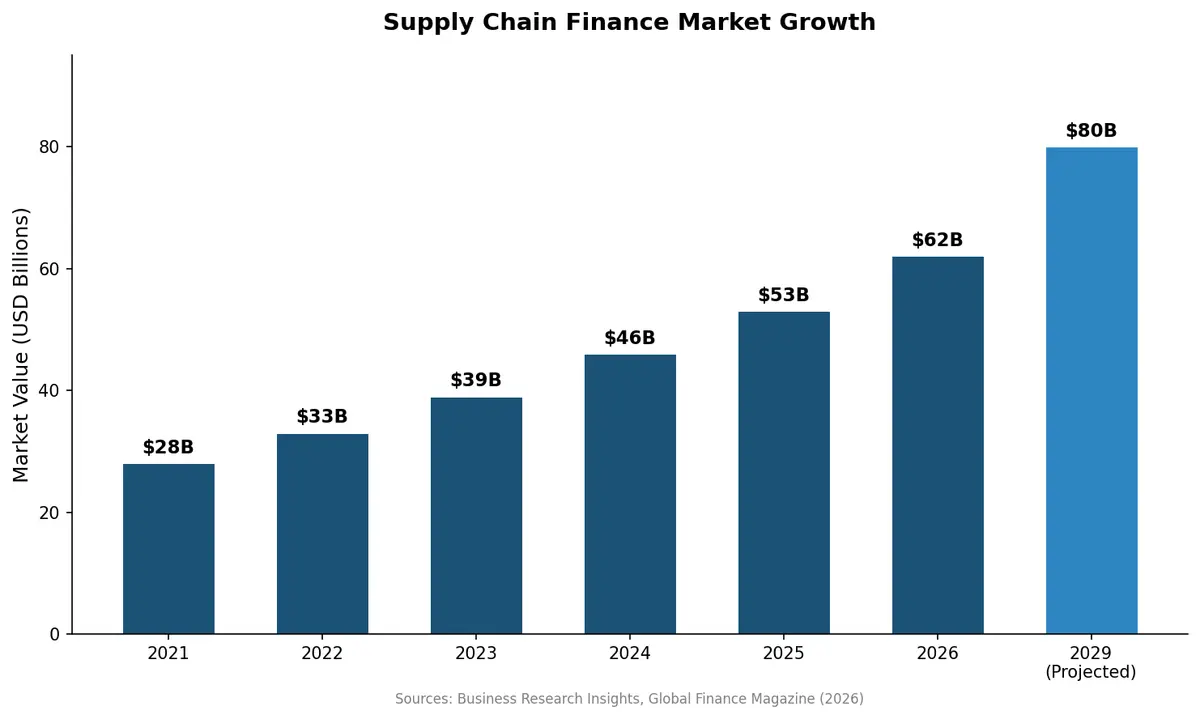
The supply chain finance (SCF) market has exploded to an estimated $62 billion in 2026, according to Business Research Insights via Global Finance Magazine. For logistics leaders wrestling with tighter margins, tariff uncertainty, and longer payment cycles, SCF is no longer a nice-to-have — it's a strategic imperative that determines whether your supply chain thrives or starves for cash.
The Working Capital Crisis No One Talks About
Here's the uncomfortable truth: cash conversion cycles are getting worse, not better. Deloitte's analysis of 2,500 listed companies found the average cash conversion cycle increased from 22.5 days in 2021 to 26.8 days in 2023 — a 19% deterioration that locked up billions in working capital across global supply chains.
Meanwhile, suppliers — especially small and mid-sized ones — are bearing the brunt. As large buyers extend payment terms to 60, 90, or even 120 days, smaller suppliers face a brutal choice: accept late payments and risk insolvency, or offer steep discounts to get paid faster. Supply chain finance bridges this gap by giving both sides what they need: buyers preserve cash, and suppliers get paid early at favorable rates.
The Hackett Group's 2025 Working Capital Survey estimates $1.7 trillion in working capital improvement opportunities among the 1,000 largest U.S. public companies alone. The companies that unlocked this capital saw a 4% cash conversion cycle improvement driven primarily by smarter payables strategies — exactly where SCF shines.
Dynamic Discounting vs. Reverse Factoring vs. PO Financing
Not all supply chain finance is created equal. Understanding when to deploy each instrument is the difference between marginal improvement and transformational working capital gains.
Dynamic Discounting
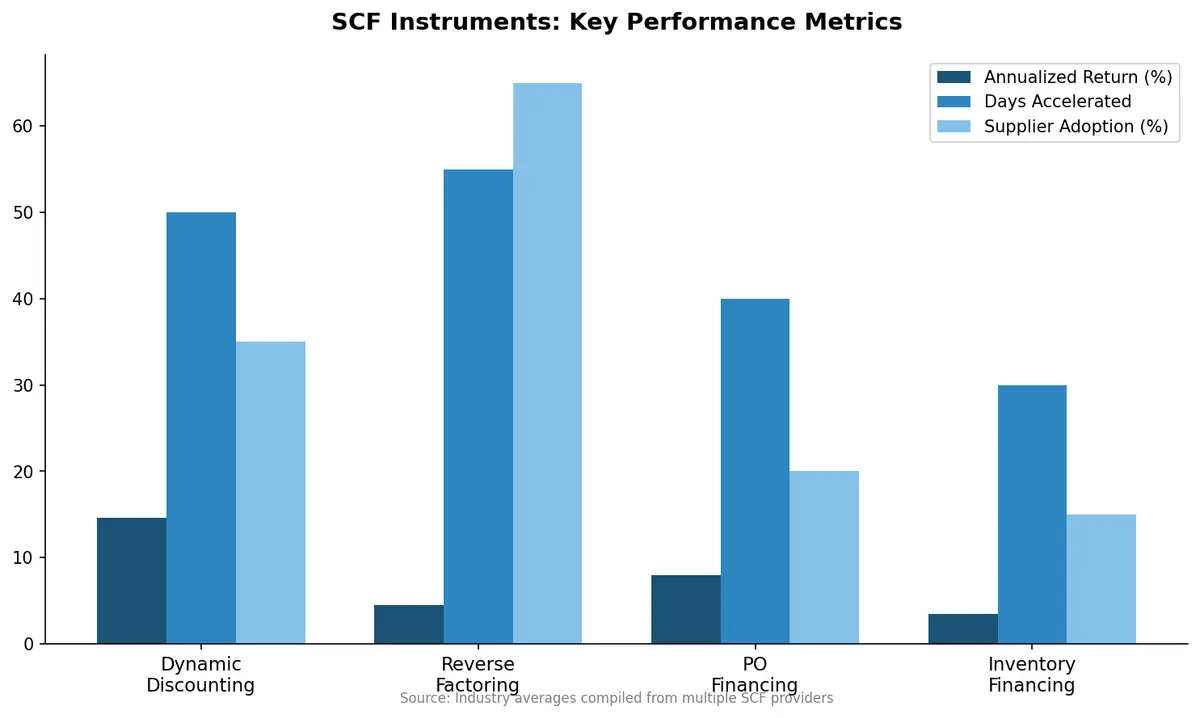
In dynamic discounting, the buyer uses its own cash to pay suppliers early in exchange for a sliding-scale discount. The earlier the payment, the larger the discount. A typical 2/10 net 60 arrangement (2% discount for payment within 10 days versus the standard 60-day term) translates to an annualized return of 14.6% on deployed cash — far exceeding what that money earns sitting in a treasury account.
Best for: Cash-rich buyers looking to earn returns on excess liquidity while strengthening supplier relationships.
Reverse Factoring (Approved Payables Finance)
In reverse factoring, a third-party financial institution pays the supplier early — typically within 5–10 days — at a discount based on the buyer's credit rating, not the supplier's. The buyer then pays the bank at the original maturity date. Because the financing leverages the buyer's stronger credit profile, suppliers access capital at rates 200–400 basis points lower than they could get independently.
Best for: Large anchor buyers with strong credit ratings who want to extend payment terms without hurting suppliers.
Purchase Order Financing
PO financing provides capital before goods are delivered, based on confirmed purchase orders from creditworthy buyers. This helps suppliers fund raw materials, manufacturing, and shipping costs. Market Research Future identifies PO financing as the fastest-growing SCF segment due to surging demand for early-stage supply chain liquidity.
Best for: Suppliers receiving large orders they lack the working capital to fulfill.
E-Invoicing: The Accelerant SCF Needed
The explosive growth in e-invoicing adoption is pouring fuel on supply chain finance. When invoices are digital, structured, and verifiable from the moment they're created, the entire SCF process accelerates. No more waiting days for paper invoices to arrive, get scanned, matched to POs, and approved.
Governments worldwide are mandating e-invoicing — the EU's ViDA (VAT in the Digital Age) directive, India's GST e-invoicing expansion, and Brazil's mature NF-e system are creating a global infrastructure that makes SCF frictionless. When an invoice is approved in real-time, a supplier can access financing within hours rather than weeks.
Fintechs vs. Banks: A Converging Landscape
The SCF market in 2026 is no longer a clean split between traditional banks and fintech disruptors. The landscape is converging. Banks like Citi, HSBC, and JPMorgan have invested heavily in digital SCF platforms, while fintechs like C2FO, Taulia (now part of SAP), and PrimeRevenue have built massive supplier networks that rival bank reach.
The real differentiator? Data integration. The winners are platforms that connect directly into ERP and TMS systems, automatically identifying invoices eligible for early payment and executing financing decisions without manual intervention. McKinsey research shows that companies aligning incentives around cash collection and payables optimization achieve 20% or greater improvement in accounts receivable performance.
What This Means for Logistics Operations
For logistics and supply chain teams, SCF isn't just a finance department initiative — it directly impacts operations:
- Carrier payment acceleration: Paying carriers faster improves tender acceptance rates and secures capacity during peak seasons
- Supplier stability: Financing your upstream suppliers reduces the risk of disruption from supplier insolvency
- Freight cost reduction: Offering dynamic discounts to logistics providers can reduce effective freight costs by 1–3%
- Inventory financing: Fund strategic inventory buffers without tying up operating cash
The key enabler is TMS-to-ERP integration. When your transportation management system generates freight invoices, matches them against contracts and proof-of-delivery, and pushes approved payables into an SCF platform automatically, you compress the order-to-cash cycle from weeks to days.
Building Your SCF Strategy
Companies looking to implement or expand supply chain finance in 2026 should follow a structured approach:
- Audit your cash conversion cycle — Map DSO, DIO, and DPO across your supply chain to identify the biggest improvement levers
- Segment your supplier base — Strategic suppliers with tight margins benefit most from reverse factoring; tail-spend suppliers may respond better to dynamic discounting
- Invest in integration — SCF programs fail when they require manual invoice processing. Automate the invoice-to-approval pipeline through your TMS and ERP
- Start with a pilot — Launch with your top 20 suppliers by spend volume, measure working capital improvement, then scale
- Track the right metrics — Monitor supplier adoption rates, average days-to-payment, discount capture rates, and net working capital impact
Ready to connect your logistics operations with smarter financial workflows? Contact CXTMS to see how our TMS platform integrates with supply chain finance solutions to accelerate payments and optimize working capital.