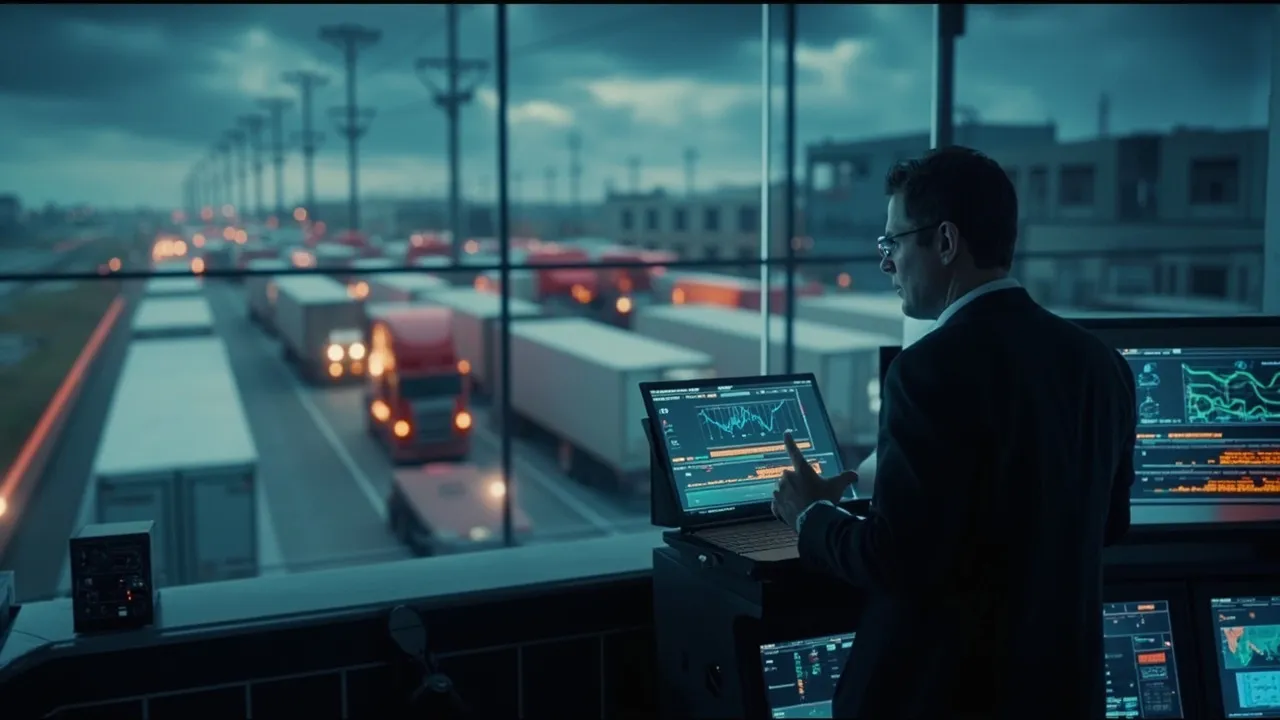
India Road Freight’s $168.51B Market Shows Why Domestic Linehaul Needs Digital Discipline


India’s road freight market is no longer just a domestic transport story. It is becoming a test of whether high-growth logistics markets can scale without drowning dispatch teams in phone calls, spreadsheets, detention disputes, and late exception reporting.
Mordor Intelligence estimates the India road freight transport market at $168.51 billion in 2026, growing at an 8.72% CAGR to $255.92 billion by 2031. That is a huge amount of freight moving through a system where manufacturing expansion, rural FMCG distribution, construction demand, tier-2 warehousing, multimodal corridors, and quick-commerce density are all pulling road networks in different directions at once.
The size of the opportunity is obvious. The operational warning is sharper: more freight does not automatically create better freight execution. Without digital discipline, growth simply multiplies the number of late trucks, vague ETAs, missed appointment windows, unverified proof-of-delivery documents, and customer service escalations.
Growth is coming from several freight profiles at once
The most interesting detail in Mordor’s outlook is not only the headline market size. It is the mix of demand drivers behind it. The report attributes positive growth impact to manufacturing under Make in India, FMCG distribution into rural and semi-urban markets, construction and infrastructure material movement, warehousing expansion across tier-2 and tier-3 cities, dedicated freight corridors, and quick commerce.
Those are not interchangeable transport flows.
A manufacturing lane from an electronics cluster needs predictable pickup windows, component-level handling discipline, and tight supplier coordination. FMCG replenishment into semi-urban markets needs frequent smaller moves, route density, stock availability, and clean delivery confirmation. Construction freight needs site-slot discipline, heavy equipment visibility, and tighter sequencing as modular building methods increase shipment frequency. Quick commerce pushes still another operating model, where high-frequency replenishment and local node performance matter more than long-haul asset optimization.
That is why “road freight growth” is too blunt a category. The practical issue is whether transportation teams can configure each lane type with the right milestones, appointment rules, carrier expectations, escalation paths, and document requirements.
A market this large cannot be managed as one giant phone tree.
Driver shortages make appointment discipline more valuable
India’s road freight growth is happening against real constraints. Mordor reports a shortage of around 2.2 million skilled drivers, with only 55 to 60 drivers available for every 100 trucks. It also says fuel represents more than 40% of road transport operating costs, making margins highly sensitive to diesel volatility and delays in rate pass-through.
Those numbers matter because they change the economics of sloppy execution. A truck waiting outside a warehouse gate is not just an inconvenience; it is scarce driver time being wasted. A missed unloading slot can break the next pickup plan. A poorly communicated delay can turn into detention, failed customer promises, and unnecessary spot-market capacity.
Digital linehaul discipline starts with boring but powerful basics: appointment scheduling, gate-in and gate-out capture, loaded and empty status, driver contact workflows, geofenced milestone updates, temperature or handling notes where required, and document capture before the shipment disappears into reconciliation.
None of that is glamorous. It is also exactly what separates scalable freight operations from manual brokerage chaos.
Multimodal corridors increase the need for synchronized road legs
India’s freight future is not road-only. Dedicated freight corridors, logistics parks, rail interfaces, and port-linked infrastructure are meant to shift more volume into coordinated multimodal networks. Deloitte’s India economic outlook notes that government capital expenditure remained high, at 3.4% of GDP in the first half of fiscal 2025 to 2026, with infrastructure among the priority areas supporting domestic demand.
For road freight teams, that does not reduce the importance of trucks. It makes truck timing more important.
When a road leg feeds rail, port, warehouse, or export cutoff windows, linehaul execution becomes part of a broader synchronized plan. A late pickup can miss an intermodal departure. A missing document can create dwell at a logistics park. A poor ETA can force warehouse labor to wait or reschedule. A disconnected carrier update can leave the shipper blind even when the physical freight is still recoverable.
The best road networks will not simply add more vehicles. They will connect domestic transport milestones to cross-dock schedules, export documentation, customer delivery commitments, and exception workflows.
That matters for global shippers as much as domestic ones. India-linked exports depend on reliable domestic legs before the container, air waybill, or cross-border handoff ever enters the picture.
Visibility is only useful if it drives exception handling
Supply chain technology discussions often overuse the word visibility. In a fragmented road freight market, visibility alone is not enough. A dot on a map does not solve a missed appointment, a driver shortage, a fuel surcharge dispute, or a customer escalation.
The useful version of visibility is operational: Which shipment is at risk? Who owns the next action? What document is missing? Which carrier is repeatedly late on the same lane? Which warehouse is creating avoidable dwell? Which customer needs a revised ETA before the delay turns into a service failure?
That is why the connection between data governance and execution is so important. SupplyChainBrain recently highlighted the need to close the gap between supply chain ambition and execution, noting that resilience depends on reducing the time needed to resolve problems and that organizations still relying on spreadsheets and manual processes often struggle to turn digital investments into business results.
India road freight is a perfect example. The market does not need technology theater. It needs structured operating data: lane rules, carrier scorecards, exception codes, appointment performance, proof-of-delivery status, fuel and accessorial logic, and customer notification workflows.
What freight teams should build now
Shippers, forwarders, and 3PLs serving India should treat road freight scale as a systems-design challenge. Four capabilities deserve priority.
First, standardize linehaul milestones by lane type. Manufacturing, FMCG, construction, quick commerce, and export feeder routes should not be forced into the same milestone template.
Second, make carrier performance measurable. On-time pickup, on-time delivery, dwell, rejection, document accuracy, communication responsiveness, and exception closure time should be visible by carrier, lane, facility, and customer.
Third, connect domestic transport to export readiness. Road legs should carry the shipment context needed for customs, port cutoffs, warehouse planning, and customer service, not operate as a disconnected prelude to international freight.
Fourth, automate the routine so humans can manage the exceptions. Dispatch teams should not spend their day asking where the truck is. They should be solving the shipments where timing, documentation, capacity, or customer commitments are already at risk.
India’s $168.51 billion road freight market is big enough to reward companies that build disciplined execution now. By 2031, at a projected $255.92 billion, manual workarounds will not look scrappy. They will look expensive.
CXTMS helps freight teams bring structure to fast-moving road and multimodal operations: configurable milestones, carrier workflows, document control, visibility, exception management, and customer updates in one transportation platform.
Schedule a CXTMS demo to see how digital freight execution can support India growth without adding operational chaos.