GXO and KION Deploy First AI-Driven Autonomous Industrial Truck in Live Warehouse: What Physical AI Means for 3PL Operations

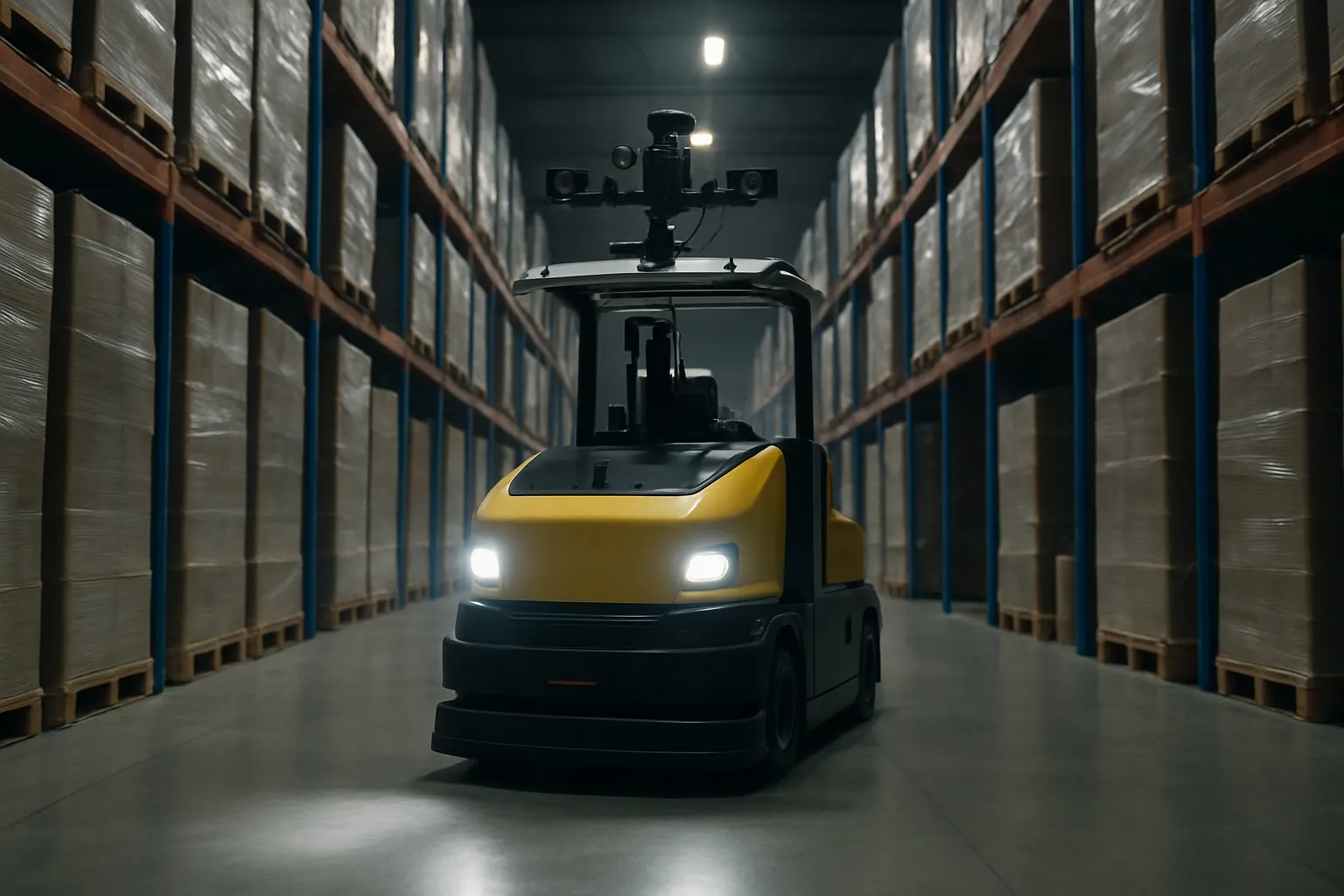
When a fully autonomous industrial truck navigates a live warehouse floor — detecting pallets with AI-powered cameras, plotting transport routes through a digital twin, and completing end-to-end missions without a single human touch — it stops being a proof of concept and starts being the future of contract logistics. That future arrived on March 18, 2026, at a GXO Logistics facility in Épinoy, France.
GXO, the world's largest pure-play contract logistics provider, just deployed the first AI-driven autonomous industrial truck powered by KION Group in a live, high-volume warehouse environment. The pilot, announced alongside NVIDIA's GTC 2026 conference in San Jose, represents the moment physical AI moved from simulation labs into real-world supply chain operations — and it carries major implications for every 3PL and shipper evaluating warehouse automation strategies.
The Deployment: Épinoy as a Live Proving Ground
The collaboration is a four-way partnership: KION Group, one of the world's leading industrial truck and warehouse solutions providers, built the autonomous vehicle. NVIDIA contributed the compute platform and simulation infrastructure. Accenture provided integration and digital twin engineering. And GXO offered what none of the technology partners could — a real, operational warehouse with live inventory, active workers, and genuine throughput demands.
At the Épinoy facility, KION's autonomous truck completes full end-to-end transport missions without human intervention. The vehicle detects pallets using a combination of AI-based ceiling-mounted and onboard cameras, constructs spatial awareness through digital twin mapping of the warehouse environment, and autonomously navigates to defined drop locations. This isn't a guided vehicle following a magnetic strip on the floor. It's a machine that perceives, decides, and acts.
GXO CEO Patrick Kelleher framed the deployment as a signal of where the company is heading: "As we integrate advanced AI into our operations, our priority is creating real, measurable impact. Exploring autonomous capabilities in live warehouse pilots is part of how we continue to innovate and build an increasingly intelligent and resilient supply chain."
Inside KION's Physical AI Stack
The term "physical AI" distinguishes this technology from the software-only AI that dominates logistics headlines. Physical AI combines perception, decision-making, and real-world actuation — the machine doesn't just analyze data, it moves things.
KION's stack for this deployment involves several integrated layers:
Spatial scanning and digital twin mapping. Before the autonomous truck operates, the warehouse environment is scanned and reconstructed as a physics-accurate digital twin using NVIDIA Omniverse. This digital replica allows engineers to simulate thousands of transport scenarios, identify collision risks, and optimize navigation paths before deploying anything in the physical world.
AI-based perception. Ceiling-mounted cameras and onboard sensors give the truck a continuous, 360-degree understanding of its environment. The perception system identifies pallets, obstacles, human workers, and dynamic changes in the warehouse layout in real time.
Autonomous navigation and mission execution. Unlike traditional automated guided vehicles (AGVs) that follow predetermined paths, KION's truck plans and executes complete transport missions dynamically. It picks up pallets at origin points, navigates through active warehouse aisles, and delivers to destination locations — adapting to obstacles and traffic as it moves.
Safety-certified human detection. Perhaps the most critical component is the AI-based human detection system, which has been developed to meet safety certification standards for mixed human-robot environments. This is the technology that makes it possible to deploy autonomous trucks in warehouses where human workers are still present — a requirement for virtually every real-world 3PL operation.
Why This Matters: The AMR Market Is Exploding
GXO and KION aren't operating in a vacuum. The autonomous mobile robot (AMR) market is projected to grow from $3.4 billion in 2026 to $17 billion by 2035, according to Global Market Insights, representing a 19.5% compound annual growth rate. MarketsandMarkets pegs the segment at $2.75 billion in 2026, reaching $7.07 billion by 2032 at a 14.4% CAGR, with logistics and warehousing as the dominant application area.
The autonomous forklift sub-segment specifically is on a trajectory from $5.75 billion in 2025 to $10.24 billion by 2030 at a 12.25% CAGR. The labor economics driving this growth are straightforward: warehouse labor costs continue to rise, turnover rates in distribution centers remain above 40% annually in many markets, and the volume of goods flowing through fulfillment networks keeps climbing with e-commerce growth.
What makes the GXO-KION deployment different from the dozens of AMR pilots announced at trade shows is the operational context. GXO operates more than 1,000 facilities totaling over 200 million square feet globally, with over 150,000 team members. When GXO validates autonomous technology in a live environment, it creates a deployment template that can scale across one of the world's largest warehouse networks.
3PL Implications: From Pilot to Fleet Deployment
For 3PLs watching this space, the GXO-KION pilot reveals the emerging playbook for autonomous warehouse vehicle adoption:
Start with digital twins, not hardware. The NVIDIA Omniverse simulation layer means 3PLs can model autonomous operations in their existing facilities before committing capital. Digital twin testing reduces deployment risk and accelerates the path from pilot to production.
Mixed human-robot environments are the realistic path. Full "lights-out" warehouses remain rare. The safety-certified human detection system in KION's stack acknowledges that autonomous vehicles will share space with human workers for years to come. 3PLs should evaluate automation solutions based on their ability to operate safely alongside existing teams, not in isolation.
Multi-site scalability is the real value. A single autonomous truck in one French warehouse is interesting. The ability to replicate that deployment across hundreds of sites using standardized digital twin models and consistent AI perception systems is transformative. GXO's scale makes it the ideal partner for proving this model.
Technology partnerships are deepening. As Supply Chain Dive has reported, warehouse automation partnerships between 3PLs and technology providers are becoming increasingly strategic rather than transactional. The GXO-KION-NVIDIA-Accenture collaboration isn't a vendor relationship — it's a co-development model where the logistics operator shapes the technology roadmap.
Safety Certification: The Quiet Enabler
The piece of this announcement that deserves more attention is KION's AI-based human detection for automated trailer loading. While the autonomous truck gets the headlines, the safety certification work is what unlocks commercial deployment at scale.
Regulatory and liability frameworks for autonomous vehicles in warehouses are still evolving. But KION's approach — building human detection capabilities that meet safety certification standards — addresses the primary concern that has slowed adoption: the risk of autonomous vehicles injuring human workers in shared spaces.
For operations leaders evaluating autonomous warehouse vehicles, the question has shifted from "can it navigate?" to "can it operate safely alongside my team?" KION's answer at Épinoy appears to be yes — and that changes the calculus for every 3PL considering the investment.
What This Means for Shippers Using CXTMS
For shippers managing freight through CXTMS, the rise of physical AI in 3PL warehouses creates a new dimension for partner evaluation. When selecting and managing warehouse and fulfillment partners, understanding their automation capabilities — and specifically their autonomous vehicle deployment roadmap — becomes a competitive differentiator.
CXTMS platforms enable shippers to track operational performance across their 3PL network, benchmark throughput and accuracy metrics, and identify which facilities are leveraging automation to drive cost savings and service improvements. As autonomous vehicles like KION's truck become standard equipment in leading 3PL operations, the performance gap between automated and manual facilities will widen — and shippers who can measure that gap will make better sourcing decisions.
The warehouse of 2030 won't look like the warehouse of 2020. GXO and KION just showed us what the transition looks like in practice. The 3PLs and shippers that move early on physical AI won't just be more efficient — they'll be operating in a fundamentally different competitive category.
Ready to optimize your warehouse and fulfillment partner network with data-driven insights? Request a CXTMS demo to see how our platform helps shippers evaluate 3PL automation capabilities, track operational performance, and make smarter logistics sourcing decisions.