GE Aerospace and Palantir Deploy Agentic AI Across Aviation Supply Chain: What the $1 Billion Industrial Manufacturing AI Push Means for Commercial Logistics

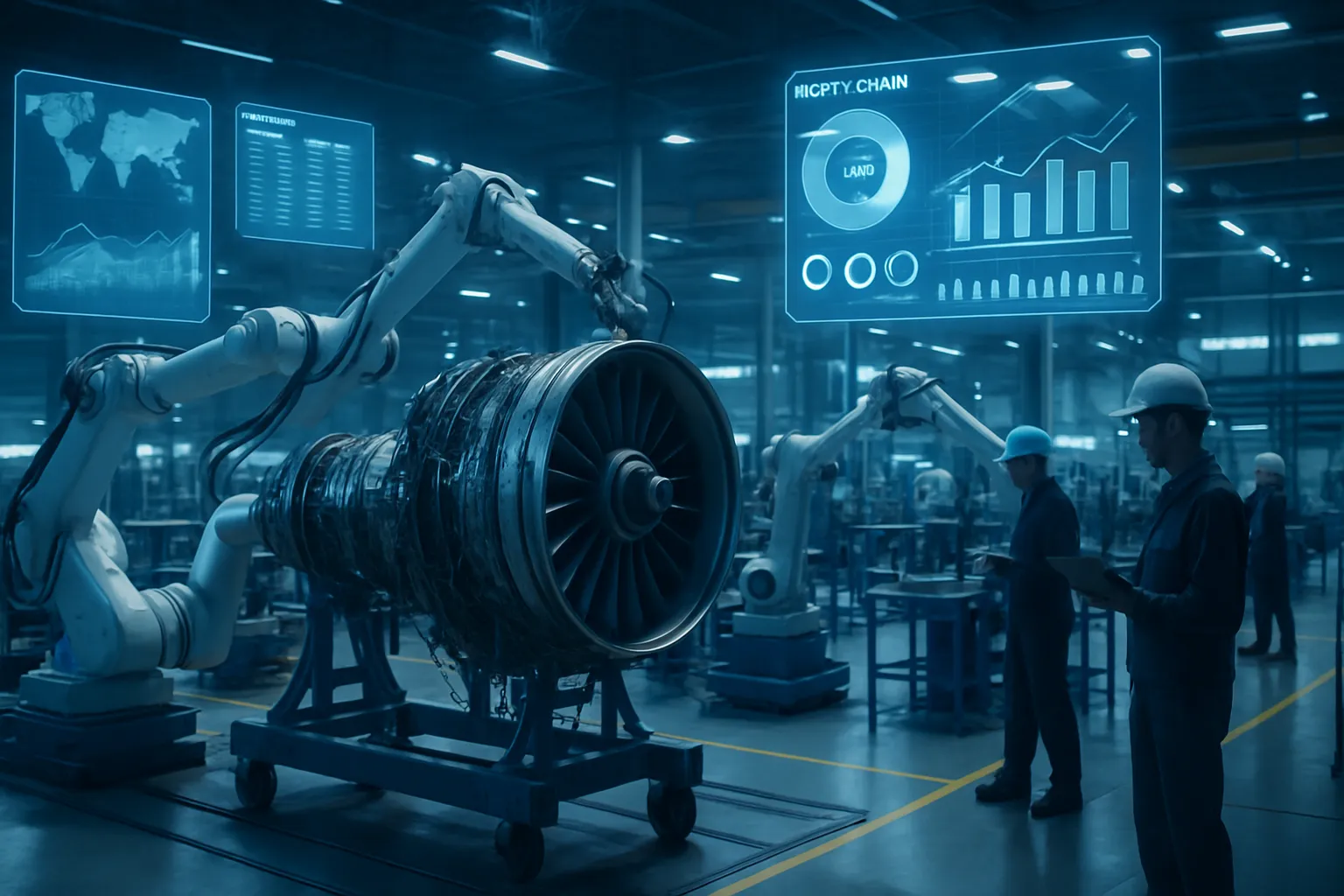
On March 12, 2026, GE Aerospace and Palantir Technologies announced an expanded multi-year partnership to transform military aircraft readiness using artificial intelligence. But the bigger story for commercial logistics isn't about fighter jets — it's about what GE Aerospace is already doing with Palantir's Artificial Intelligence Platform (AIP) across its civilian supply chain operations, deploying agentic AI to autonomously orchestrate fulfillment, sourcing, allocation, maintenance, repair, and customer service.
This expansion comes alongside GE Aerospace's announcement of another $1 billion investment in U.S. manufacturing for 2026 — the company's second consecutive billion-dollar domestic investment — spanning more than 30 communities across 17 states, with plans to hire 5,000 new U.S. workers in manufacturing and engineering roles. Combined with the 5,000 people hired in 2025, that's 10,000 new positions in two years, all supported by an AI-driven supply chain backbone.
For logistics professionals watching AI move from PowerPoint slides to production floors, the GE-Palantir deployment is the clearest enterprise case study yet of agentic AI operating at industrial scale.
What Palantir AIP Actually Does at GE Aerospace
Palantir's Artificial Intelligence Platform isn't a chatbot bolted onto existing systems. It's an operational layer that sits across GE Aerospace's entire supply chain infrastructure, connecting data from procurement, manufacturing, inventory, maintenance, and logistics into a unified decision-making framework.
At GE Aerospace, AIP is deployed across six core supply chain functions:
- Fulfillment orchestration — coordinating parts delivery across a global network of manufacturing sites, MRO (maintenance, repair, and overhaul) facilities, and airline customers
- Sourcing optimization — evaluating supplier performance, pricing, lead times, and risk across thousands of aerospace component vendors
- Allocation decisioning — determining which facilities receive scarce parts based on criticality, contractual commitments, and production schedules
- Maintenance scheduling — predicting component failures and pre-positioning replacement parts before they're needed
- Repair workflow management — routing components through inspection, repair, and certification processes
- Customer service automation — providing real-time order status, delivery estimates, and exception management
The critical difference between this deployment and typical enterprise AI is the word agentic. Traditional AI in supply chains generates recommendations for humans to approve. Agentic AI executes decisions autonomously within defined guardrails, then reports outcomes. It doesn't wait for a manager to click "approve" on a purchase order — it evaluates conditions, acts, and moves on.
Agentic AI vs. Generative AI: Why the Distinction Matters
The logistics industry has spent two years experimenting with generative AI — using large language models for demand forecasting narratives, customer communications, and document processing. These are valuable applications, but they're fundamentally passive. They generate outputs for humans to evaluate.
Agentic AI represents a fundamentally different architecture. According to Gartner's May 2025 prediction, by 2030, 50% of cross-functional supply chain management solutions will use intelligent agents to autonomously execute decisions. A subsequent Gartner survey from February 2026 found that 55% of supply chain leaders expect agentic AI to reduce entry-level hiring needs, with high-performing companies adopting agentic AI at significantly higher rates across procurement, production, logistics, warehouse management, and planning.
The progression looks like this:
| Stage | Capability | Human Role |
|---|---|---|
| Traditional Analytics | Historical reporting | Decision maker |
| Predictive AI | Forecast generation | Decision maker |
| Generative AI | Recommendation creation | Approver |
| Agentic AI | Autonomous execution | Exception handler |
GE Aerospace's deployment with Palantir sits firmly in that fourth stage. The AI doesn't ask permission to reallocate turbine blade inventory from a facility with surplus to one facing a production shortfall. It evaluates the data, confirms the action falls within policy parameters, executes the transfer, and logs the decision for human review.
What $1 Billion in AI-Backed Manufacturing Looks Like
GE Aerospace's $1 billion 2026 manufacturing investment isn't happening in isolation from its AI strategy. The two are deeply interconnected. When you're scaling production of aerospace components across 30+ communities in 17 states, the supply chain complexity is staggering — thousands of part numbers, hundreds of suppliers, strict FAA certification requirements, and zero tolerance for quality failures.
Agentic AI makes this scaling feasible. Consider the logistics challenge: a single commercial jet engine contains roughly 25,000 individual parts sourced from suppliers worldwide. GE Aerospace produces engines for both Boeing and Airbus aircraft, meaning simultaneous production ramps across multiple programs with different specifications, timelines, and delivery requirements.
Without AI-driven orchestration, managing this complexity requires armies of planners, procurement specialists, and logistics coordinators manually tracking orders, adjusting schedules, and escalating exceptions. With Palantir AIP operating as an agentic layer, much of this coordination happens autonomously — freeing human experts to focus on strategic decisions and genuine exceptions rather than routine allocation adjustments.
Lessons for Commercial Logistics Operations
GE Aerospace operates one of the world's most complex industrial supply chains, but the principles driving its AI adoption apply directly to commercial freight and logistics:
1. Start with data integration, not AI models. Palantir AIP's value at GE Aerospace comes from connecting disparate data systems into a unified operational view. Most logistics companies still operate with siloed TMS, WMS, and ERP data. Until those systems share real-time data, agentic AI has nothing to act on.
2. Define guardrails before granting autonomy. GE Aerospace doesn't let AI make unconstrained decisions. Agentic AI operates within clearly defined policy parameters — budget thresholds, quality standards, contractual obligations. Logistics companies implementing AI should establish similar boundaries: maximum spend authority, approved carrier lists, service level minimums.
3. Measure autonomous actions, not just recommendations. The ROI of agentic AI comes from actions taken, not reports generated. Track how many allocation decisions, carrier selections, or routing adjustments the AI executes autonomously — and measure outcomes against human-driven baselines.
4. Plan for the workforce shift. GE Aerospace is hiring 5,000 workers despite deploying autonomous AI. The roles are changing — more engineers, more data specialists, fewer manual coordinators. As Supply Chain Dive reported, agentic AI is poised to be particularly impactful in demand planning, forecasting, and decision-making, reshaping which skills supply chain teams need most.
The Industrial AI Playbook Is Being Written Now
Palantir's broader enterprise trajectory underscores how quickly agentic AI is moving into supply chain operations. The company secured the U.S. Navy's $448 million "ShipOS" contract in late 2025 to modernize shipbuilding supply chains, followed by a $240 million Department of Defense contract for battlefield decision support in January 2026. These military logistics applications — managing complex multi-tier supply chains under extreme constraints — are direct precursors to commercial deployment.
The aviation supply chain is arguably the most demanding commercial logistics environment in existence: life-safety certification requirements, extreme cost of downtime (a grounded aircraft costs airlines $10,000–$150,000 per hour), and global supplier networks spanning dozens of countries. If agentic AI can operate autonomously in this environment, the technology is ready for commercial freight.
How CXTMS Supports AI-Driven Supply Chain Decision-Making
The GE-Palantir deployment illustrates where enterprise logistics is headed: AI systems that don't just analyze data but actively execute supply chain decisions. CXTMS is built for this future.
Our platform provides the unified data foundation that agentic AI requires — connecting carrier performance data, rate benchmarks, shipment tracking, and cost analytics into a single operational layer. Whether you're managing truckload procurement, multimodal routing, or carrier performance evaluation, CXTMS delivers the real-time visibility that enables smarter decisions — whether made by humans or AI agents.
Ready to build the data foundation for AI-driven logistics? Request a CXTMS demo and see how unified transportation management powers the next generation of supply chain intelligence.