Electric Trucks Cross $100B Market: How Fleet Decarbonization Is Reshaping Freight Strategy

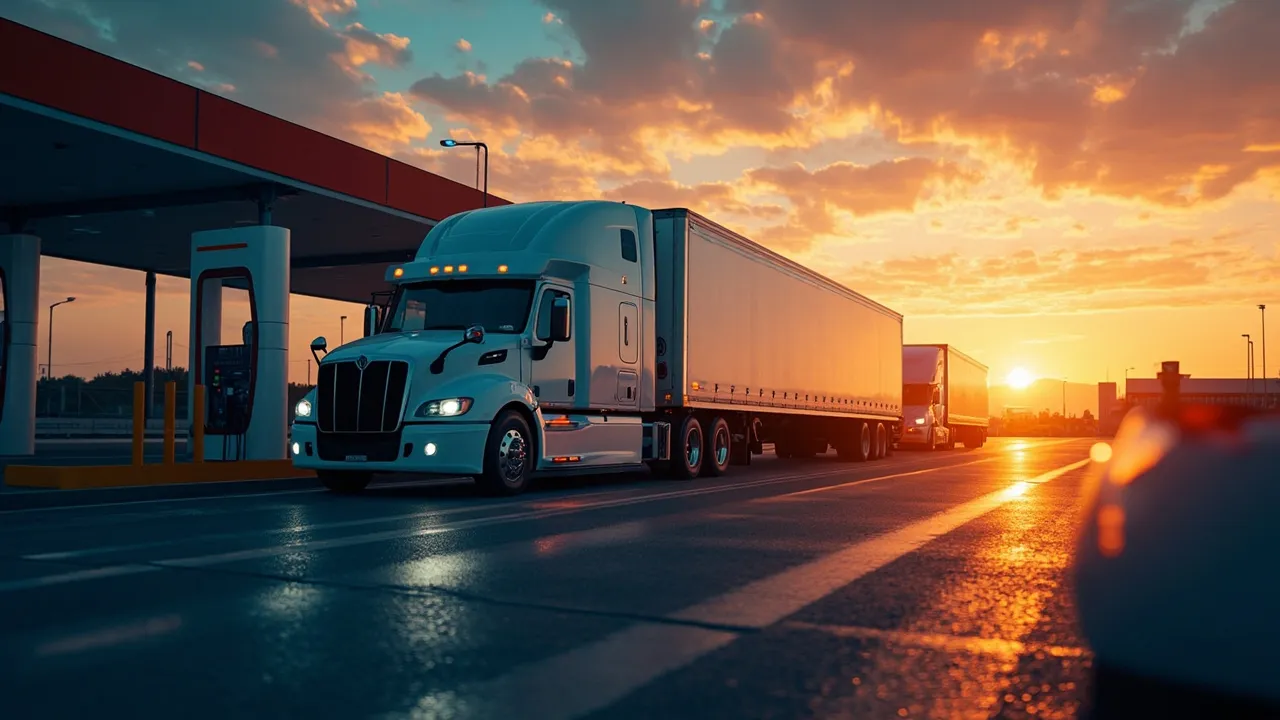
The numbers no longer require asterisks. The global electric truck market has cleared $100 billion in projected value — and the trajectory suggests it's not looking back.
According to Mordor Intelligence, the market reached USD 19.31 billion in 2026 and is on pace to hit USD 72.11 billion by 2031, growing at a compound annual rate of 30.15%. Even the conservative GlobaNewsWire projection puts 2030 at $37.95 billion, with 2026 alone at $8.54 billion — a 45% year-over-year jump. However you slice it, the market has entered a high-growth phase that carriers and shippers can no longer treat as speculative.
The inflection point isn't theoretical anymore. Tesla's Semi — the Class 8 electric truck that spent years in development purgatory — began rolling off a high-volume production line on April 29, 2026, with a target of 50,000 units per year from the Nevada facility adjacent to Giga Nevada. DHL has already confirmed a multi-unit order for 2026 delivery, reporting 1.72 kWh per mile on a fully loaded 390-mile route during testing. That's real-world efficiency data from a major logistics operator, not a prototype run.
The Major Fleet Operators Are Already Committed
Amazon, DHL, FedEx, and Walmart have each made public fleet electrification commitments that go beyond optics. These are capacity strategy decisions dressed up as sustainability pledges — because when a company the size of Amazon commits to thousands of electric delivery vans and Class 8 trucks, it changes which carriers have excess capacity for everyone else.
DHL's order book for Tesla Semis is reportedly well beyond "a handful," per reporting from TheStreet. The company's EV testing data — 1.72 kWh/mile in real freight conditions — is the kind of operational intelligence that other fleet managers are reverse-engineering to validate their own electrification roadmaps.
FedEx has targeted 100% electric vehicle acquisition by 2030 for pickup and delivery operations. Walmart's advanced alternative fuel fleet includes electric Class 8 trucks for regional distribution. These aren't fringe experiments. They're load-bearing commitments in multi-year transportation contracts.
The message for shippers is direct: carriers that delay electrification risk losing preferred carrier status with the largest shippers — and the volume that comes with it.
TCO Reality: The Gap Is Closing Faster Than Expected
The total cost of ownership argument for electric trucks has historically centered on purchase price premiums and charging infrastructure uncertainty. That argument is eroding quickly.
A new report from the North American Council for Freight Efficiency (NACFE) forecasts battery electric vehicles achieving the lowest net TCO across all modeled duty cycles by 2035, driven by a projected 45% drop in vehicle purchase prices and superior energy efficiency versus diesel. Return-to-base and drayage operations — predictable routes with depot charging — are already at TCO parity or better in many scenarios.
The practical constraint is infrastructure, not economics. Fleets running 400+ daily miles on long-haul OTR routes are still dependent on charging network density that doesn't yet exist at scale. Mobile energy storage solutions — like Xos's Hub units offering 210-630 kWh configurations — are emerging as a bridge, enabling on-site charging without requiring utility upgrades. But that's a workaround for a problem that will take years to fully solve.
For shippers, the implication is lane-specific. Routes with consistent origin-destination pairs, depot-adjacent operations, and predictable dwell time have a strong near-term electrification case. High-variance long-haul lanes will remain diesel-dependent longer — but that window is narrowing.
What This Means for Shipper Routing and Carrier Selection
Fleet electrification changes the calculus for routing decisions in ways that go beyond carbon accounting.
Carrier capability gaps are emerging. Not all carriers are investing in EV fleets at the same pace. Shippers with strong environmental procurement requirements — or those with customer ESG mandates flowing down their supply chains — need to assess carrier electrification roadmaps as part of freight procurement, not just rate and service.
Lane-level routing strategy is shifting. Shippers using TMS platforms with integrated carrier sustainability scores can now route based on EV availability by lane. For e-commerce shippers with dense regional networks, prioritizing electric-capable carriers in California, the Northeast, and select Midwest corridors can simultaneously reduce costs (lower fuel expense per mile in EV fleets) and satisfy Scope 3 emissions reporting requirements.
Contract language matters. As electric trucks scale, shippers should ensure their routing guides and carrier contracts account for EV capacity — and define how carrier EV usage is verified and reported. Without contractual hooks, the sustainability claims stay fuzzy.
The Hydrogen Wildcard
Battery electric isn't the only decarbonization path gaining commercial traction. Nikola's hydrogen fuel cell trucks are already in commercial deployment, and for routes where battery weight cuts into payload capacity or where charging dwell time is operationally unacceptable, hydrogen offers a credible alternative. The fueling time advantage — hydrogen fills in minutes versus hours for a full battery charge — remains significant for time-sensitive operations.
The infrastructure gap is even more acute for hydrogen, but the energy density argument for heavy-duty long-haul is real. Shippers with operations that push the limits of battery range should monitor hydrogen corridors as the infrastructure develops.
How CXTMS Helps You Stay Ahead of the Electrification Shift
Fleet electrification isn't just a carrier-side issue. Shippers who understand EV capacity availability by lane, can model the cost and emissions impact of routing decisions, and track carrier sustainability performance against contractual commitments are the ones who'll capture the advantages as the market matures.
CXTMS gives freight teams the carrier intelligence, lane-level routing visibility, and sustainability reporting tools to make electrified freight a competitive lever — not just a compliance checkbox.
Ready to see how CXTMS supports your electrification strategy? Schedule a demo with our team.