Digital Twins Are Revolutionizing Supply Chain Design

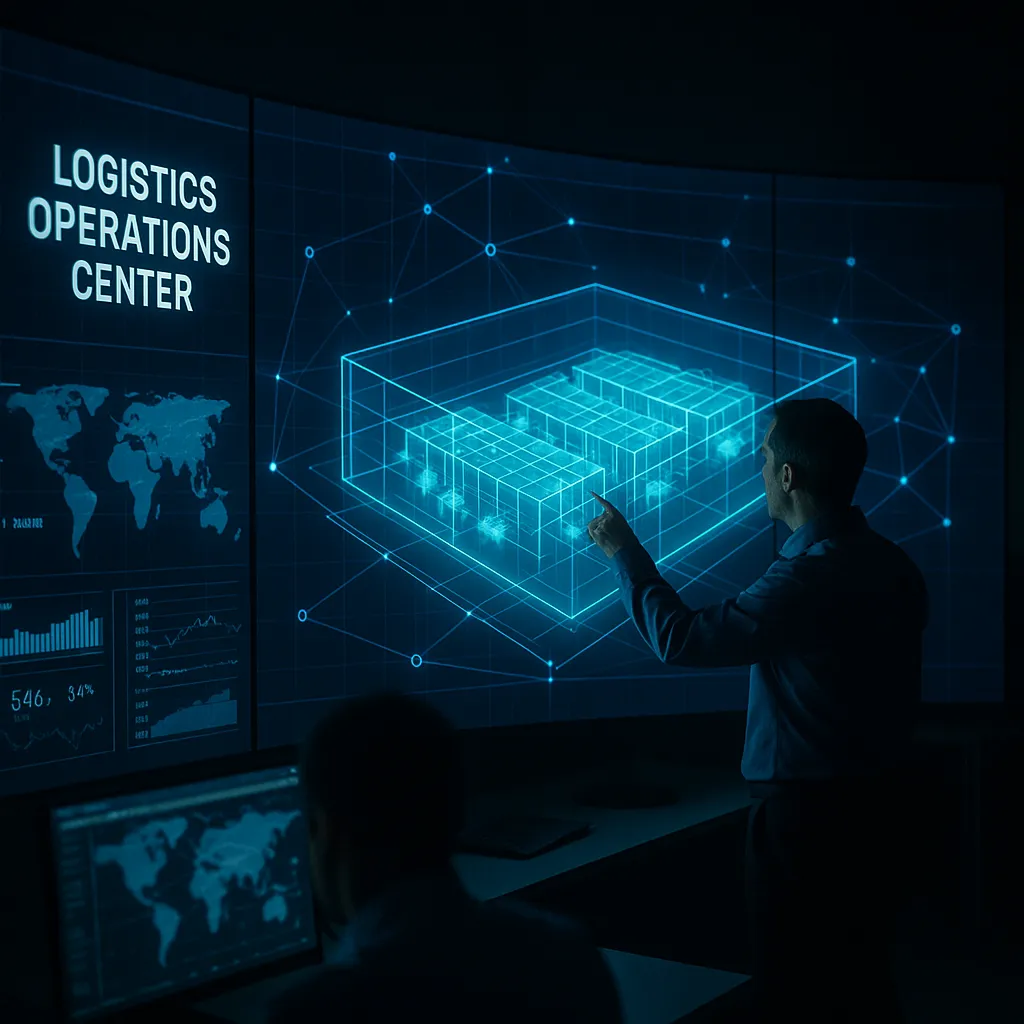
What if you could test every change to your supply chain — rerouting shipments, reconfiguring warehouses, swapping carriers — without moving a single pallet? That's the promise of digital twin technology, and in 2026, it's no longer theoretical.
The Rise of Virtual Supply Chains
The digital twin market is exploding. Valued at approximately $34 billion in 2026, it's projected to reach $385 billion by 2034 at a 35.4% compound annual growth rate, according to Fortune Business Insights. Supply chain and logistics applications are among the fastest-growing segments as companies seek ways to simulate disruption before it strikes.
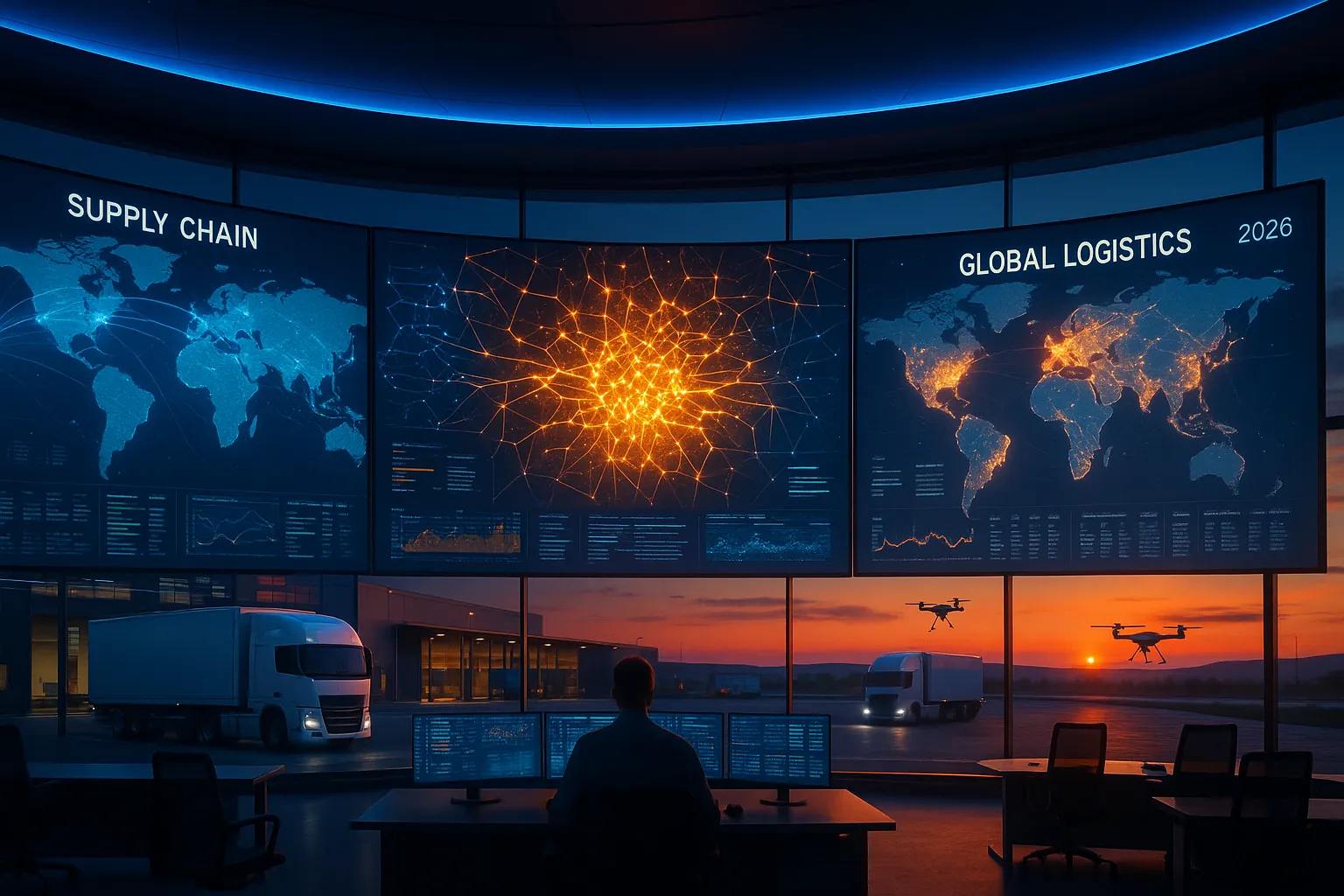
A supply chain digital twin is a living virtual replica of your entire logistics network — warehouses, transportation lanes, inventory positions, carrier performance, and demand patterns. Unlike static models, digital twins continuously ingest real-time data and update themselves, allowing operations teams to run what-if scenarios with physics-level accuracy.
PepsiCo's Bold Move with Siemens and NVIDIA
In January 2026, PepsiCo announced a multi-year collaboration with Siemens and NVIDIA to transform its plant and supply chain operations through advanced digital twin technology. The partnership leverages Siemens' newly launched Digital Twin Composer — built on NVIDIA Omniverse — to recreate every machine, conveyor, pallet route, and operator path inside PepsiCo's facilities with physics-level accuracy.
The result: AI agents can simulate, test, and refine system changes before any physical modification takes place. Instead of shutting down a production line to test a new layout, PepsiCo runs thousands of virtual scenarios in hours. The implications for cost avoidance alone are significant — a single failed warehouse reconfiguration at a major CPG company can cost millions in downtime and lost throughput.
BSH: Modeling 188 Warehouses Globally
PepsiCo isn't alone. BSH Home Appliances Group, a Bosch subsidiary operating in over 50 markets, has deployed digital twin technology across its network of 188 warehouses worldwide. Using Siemens' Supply Chain Suite, BSH created virtual replicas of its entire logistics infrastructure — both in-house and outsourced facilities.
The digital twin allows BSH to model network redesigns, evaluate new warehouse locations, and stress-test the supply chain against disruption scenarios. Instead of relying on spreadsheets and intuition, their logistics team runs data-driven simulations that account for transportation costs, service levels, and capacity constraints simultaneously.
Five Use Cases Transforming Logistics
Digital twins aren't just for global enterprises. The technology is finding practical applications across the logistics spectrum:
1. Disruption Simulation Model the impact of port closures, carrier failures, or demand spikes before they happen. Run hundreds of scenarios to build contingency plans backed by data, not guesswork.
2. Network Optimization Test warehouse placement, distribution center consolidation, or new facility locations virtually. Understand the ripple effects on transit times, costs, and service levels across your entire network.
3. Route and Carrier Optimization Simulate different carrier mixes, mode shifts (truck-to-rail, LTL-to-FTL), and routing strategies. Identify savings opportunities without the risk of live experimentation.
4. Capacity Planning Forecast seasonal peaks and model warehouse throughput under different staffing and automation configurations. Avoid over-investing in capacity you won't need — or under-investing and missing demand.
5. Sustainability Modeling Calculate the emissions impact of network changes before implementation. Test greener transportation strategies and measure their effect on both carbon footprint and cost.
The ROI of Simulation Over Experimentation
The business case for digital twins comes down to one principle: virtual mistakes are free; physical ones are expensive. Reconfiguring a warehouse layout costs weeks of planning, labor, and potential downtime. Testing that same reconfiguration in a digital twin takes hours and costs nothing beyond the platform investment.
According to FreightWaves, the combination of AI and digital twin technology allows companies to create simulations that test different scenarios and optimize operations continuously — turning supply chain design from a periodic planning exercise into an always-on optimization engine.
Early adopters report measurable gains: reduced transportation costs through network optimization, fewer failed warehouse projects, faster response to disruption, and more confident capital expenditure decisions. The companies investing in digital twins today are building a structural advantage that compounds over time.
How TMS Data Powers Digital Twins
A digital twin is only as good as the data feeding it. This is where your Transportation Management System becomes critical. Every shipment, every carrier interaction, every delivery timestamp, and every exception logged in your TMS is raw material for building an accurate virtual supply chain.
CXTMS captures the granular operational data — carrier performance metrics, lane-level transit times, cost breakdowns, and exception patterns — that digital twin platforms need to produce realistic simulations. When your TMS data is clean, comprehensive, and accessible, your digital twin reflects reality rather than assumptions.
The future of supply chain planning isn't about reacting faster. It's about simulating the future before it arrives and making decisions with confidence. Digital twins make that possible — and the data starts with your TMS.
Ready to build the data foundation for next-generation supply chain planning? Contact CXTMS for a demo.