Circular Supply Chain Design Goes Mainstream: How Tesla, IKEA, and Leading Brands Are Proving Closed-Loop Logistics Work

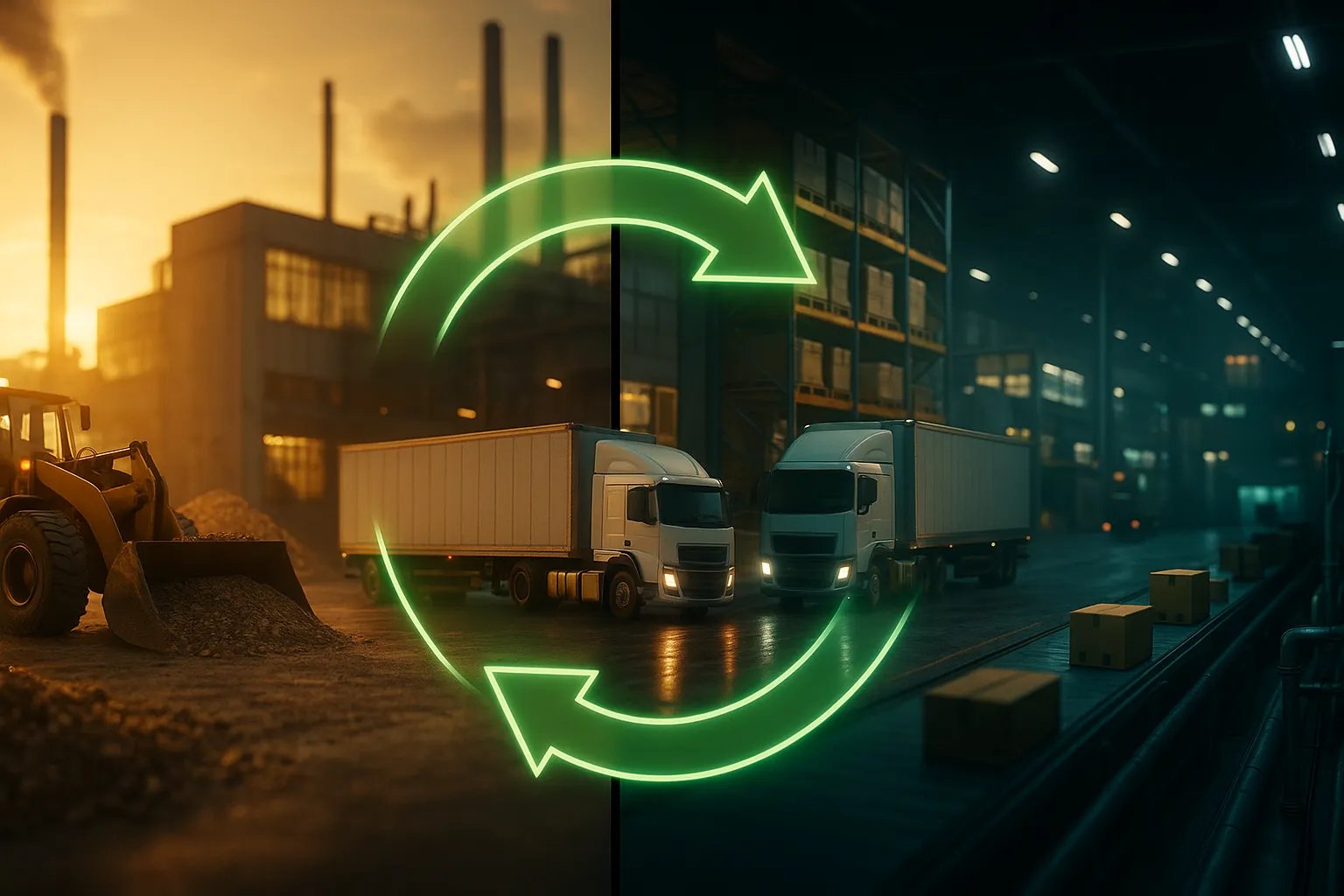
The linear supply chain — extract, manufacture, ship, dispose — is running out of road. Circular economy transactions generated $339 billion in revenue in 2022, with forecasts projecting that figure to more than double to $713 billion by 2026, a staggering 110% increase. The brands winning this shift aren't treating circularity as a PR initiative. They're redesigning their entire supply chains around closed-loop material flows — and reaping measurable financial and operational rewards.
From Linear to Closed-Loop: The Circular Imperative
Traditional supply chains treat waste as an externality. Circular supply chains (CSCs) treat it as an input. The difference isn't philosophical — it's structural. As Joseph Sarkis detailed in the March 2026 issue of Supply Chain Management Review, circular supply chains "enable the flow of materials in closed loops," delivering benefits that extend far beyond environmental compliance into resilience, efficiency, and economic performance.
The Aluminum Association estimates that recycled aluminum uses up to 95% less energy than aluminum produced from extracted ore. When you apply that kind of efficiency gain across an entire supply chain — from raw material sourcing through manufacturing, distribution, and end-of-life recovery — the compounding cost savings become transformative.
The Ellen MacArthur Foundation reports that consumer goods companies replacing virgin materials with recycled alternatives save an average of $2.8 million annually per $100 million in revenue. That's not a rounding error — it's a strategic advantage.
Tesla: Topping the Leaderboard with Closed-Loop Battery Supply Chains
Tesla has secured the number one position on the 2026 Lead the Charge automotive supply chain leaderboard for the second consecutive year, surpassing industry giants like Ford, Volvo, Mercedes, and Volkswagen. The ranking reflects Tesla's systematic approach to circular material flows rather than incremental sustainability tweaks.
Tesla's facilities now recycle up to 92% of battery materials — including lithium, cobalt, nickel, and aluminum — directly back into new battery cells. This closed-loop battery supply chain addresses one of the most critical vulnerabilities in EV manufacturing: dependence on geopolitically volatile mineral supply chains.
The company also disclosed a new offtake agreement for low-carbon aluminum in North America with an emission intensity below 2 kg of CO₂e per kg of aluminum, achieved commercially through post-consumer recycled scrap content. By designing the supply chain for material recovery from inception, Tesla has turned circular logistics from a cost center into a competitive moat.
IKEA: Zero-Emission Deliveries Meet Circular Product Design
IKEA's supply chain transformation has earned recognition as a global benchmark for sustainable retail logistics. But what distinguishes IKEA's approach is the integration of circular product design with logistics execution — designing products for disassembly, repair, and material recovery while simultaneously decarbonizing the delivery infrastructure that moves them.
The company is pushing for zero-emission deliveries in urban areas while optimizing freight networks to reduce both cost and carbon. IKEA's target of having 50% of all materials from renewable or recycled sources is now complemented by a broader supply chain overhaul targeting a 50% emissions reduction by 2030 and net zero by 2050.
Within their stores, circular principles extend to food operations with lower-carbon, plant-forward menus and traceable sourcing. IKEA's Ingka Group has invested over $1 billion into recycling ventures, signaling that circular supply chain investment at scale is not experimental — it's strategic.
Electronics: Reclaiming Rare Metals from End-of-Life Products
The electronics sector faces a unique circular supply chain challenge: products contain critical rare earth elements that are expensive to extract, environmentally damaging to mine, and concentrated in geopolitically sensitive regions. Circular design offers a way out.
Companies recovering and reusing rare earth elements from end-of-life electronics are creating alternative material sources that reduce dependency on vulnerable global supply chains. This isn't just sustainability — it's supply chain security. As the SCMR analysis notes, end-of-life materials can be collected and processed near urban centers, keeping resource flows closer to demand and bypassing trade barriers, tariffs, and political conflicts.
The smartphone industry alone generates an estimated 50 million metric tons of e-waste annually, containing billions of dollars in recoverable gold, silver, palladium, and rare earth metals. Forward-thinking manufacturers are now designing products with standardized, easily separable components that make material recovery economically viable at scale.
Why Forward and Reverse Supply Chains Must Co-Design
The most common failure in circular supply chain initiatives is treating reverse logistics as an afterthought — bolting return channels onto supply chains designed exclusively for one-way product flow. The brands succeeding at circularity understand that forward and reverse supply chains must be co-designed from the beginning.
This means lifecycle assessments at the product design stage that account for disassembly costs, material recovery rates, and reverse logistics routing. It means inventory systems that track not just finished goods flowing out, but recoverable materials flowing back. And it means transportation networks optimized for both outbound delivery and inbound material collection.
Circularity also strengthens localization strategies that reduce exposure to global disruptions. Regional collection and reprocessing loops keep materials circulating within domestic networks, reducing dependence on extended international freight lanes that are vulnerable to port congestion, geopolitical conflict, and tariff escalation.
The Business Case Is No Longer Theoretical
The data is clear: circular supply chain design delivers measurable returns across multiple dimensions:
- Cost reduction: 95% energy savings on recycled aluminum; $2.8M annual savings per $100M revenue from material substitution
- Supply chain resilience: Reduced dependence on volatile raw material markets and geopolitically concentrated mineral sources
- Regulatory compliance: Alignment with EU taxonomy requirements, extended producer responsibility (EPR) mandates, and emerging circular economy legislation
- Revenue generation: Circular economy transactions on track to reach $713 billion globally by 2026
- Brand equity: Consumer and investor demand for ESG-aligned operations continues to accelerate
How CXTMS Supports Circular Logistics Operations
Building a circular supply chain requires visibility and coordination across both forward and reverse material flows — exactly the kind of complexity that modern TMS platforms are built to manage.
CXTMS provides the logistics infrastructure for circular operations: optimized routing for both outbound delivery and inbound material recovery, returns management with configurable disposition workflows, and multi-modal freight planning that accounts for the unique characteristics of recycled material shipments.
Whether you're designing a closed-loop battery supply chain, managing retail product take-back programs, or coordinating e-waste collection across distributed networks, CXTMS gives you the end-to-end visibility needed to make circular logistics operationally viable and financially sustainable.
Ready to build circular logistics into your supply chain strategy? Request a CXTMS demo today and discover how integrated forward and reverse supply chain management can turn sustainability commitments into competitive advantage.