California Drafts Autonomous Trucking Rules: How the Largest State Market Opening Could Reshape National Freight Strategy

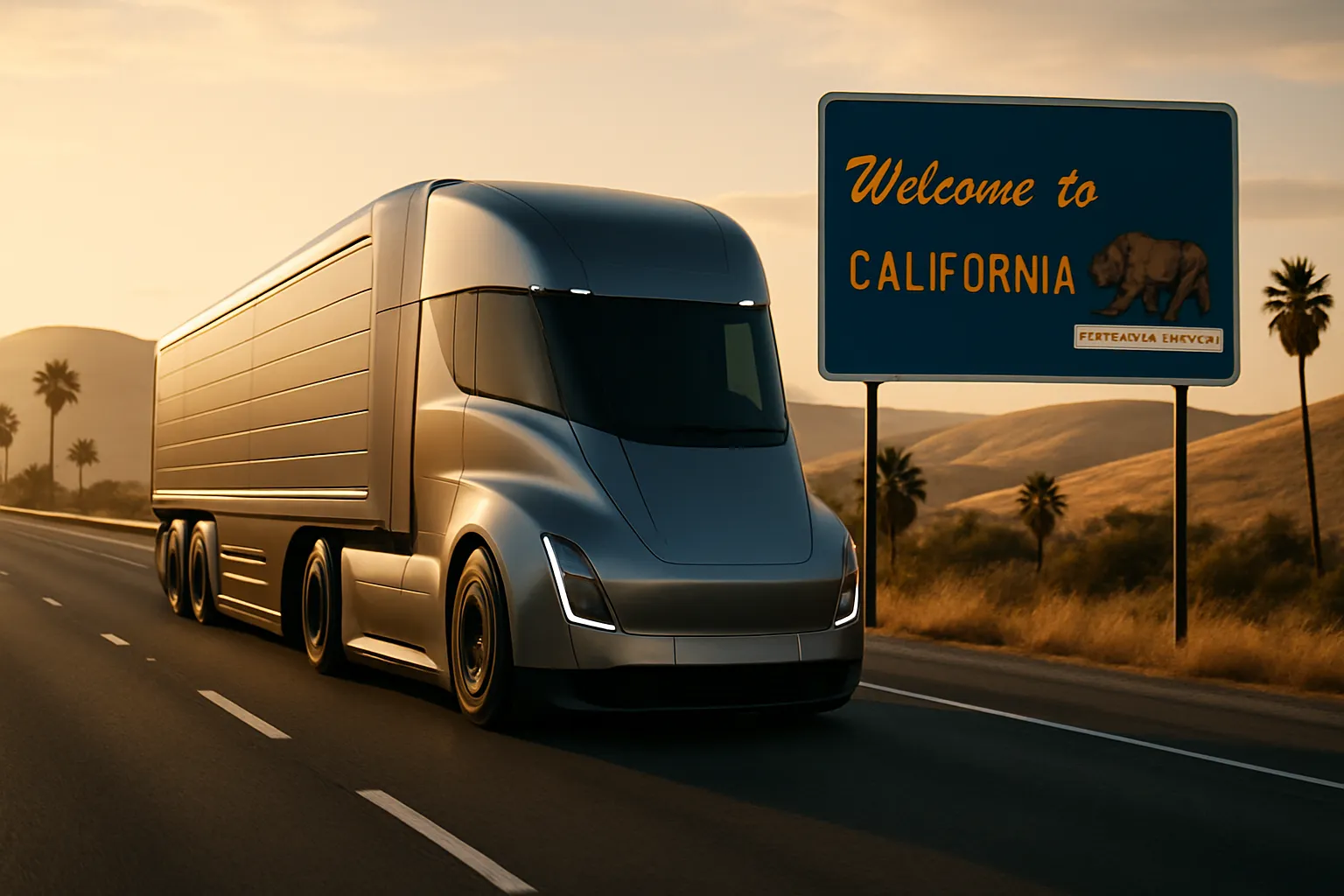
California is on the verge of a seismic shift in freight transportation. The state's Department of Motor Vehicles expects to complete its autonomous trucking rulemaking process by the end of April 2026, potentially opening the nation's largest state freight market to driverless heavy-duty trucks for the first time. For shippers, carriers, and logistics planners, this isn't just a regulatory footnote — it's a potential inflection point that could redefine lane pricing, capacity planning, and technology adoption across the entire national freight network.
What the California DMV's Proposed Regulations Actually Allow
California's DMV has been developing regulations that would allow autonomous vehicles over 10,000 pounds — including Class 8 semi-trucks — to be tested and eventually deployed on state highways. The proposed rules went through a second 15-day public comment period that ran from January 21 through February 5, 2026, and the DMV has indicated it aims to finalize the framework by the end of April 2026.
Currently, California permits driverless vehicles only under 10,000 pounds, primarily ride-hailing passenger cars. Heavy-duty autonomous trucks still require human safety drivers behind the wheel. The new regulations would create a phased pathway for testing and commercial deployment of driverless trucks on designated highway corridors, subject to safety reporting requirements and permit conditions.
This is a dramatic departure from where California stood just a few years ago. In 2023, the state legislature overwhelmingly passed AB 316, which would have effectively banned driverless trucks by permanently requiring human safety monitors. Governor Newsom vetoed that bill, stating that "existing law provides sufficient authority to create the appropriate regulatory framework" and directing the DMV to develop proper rules instead.
The Political Tug-of-War: Innovation vs. Labor
California's autonomous trucking debate is one of the most politically charged freight issues in the country. On one side, companies like Kodiak AI, Aurora Innovation, and Waymo see California as essential to coast-to-coast autonomous operations. On the other, the Teamsters union — representing over 1.2 million members nationally — has mounted an aggressive campaign to block driverless trucks.
According to Politico's March 2026 reporting, the political dynamics are shifting again as California's 2026 gubernatorial race heats up. Former Democratic Rep. Katie Porter, who secured an early endorsement from the California Teamsters, has signaled support for legislation that would largely prohibit autonomous delivery to homes and businesses.
The Teamsters have cited polling showing that more than three in four California residents support restrictions on autonomous trucking. Meanwhile, the Autonomous Vehicle Industry Association (AVIA) argues that California's safety experts — not politicians — should regulate the technology based on data and evidence.
This political uncertainty creates real planning risk for shippers and carriers who need to make multi-year fleet and route investments.
Why California's Freight Market Is the Prize
To understand why California's autonomous trucking rules matter far beyond state borders, consider the sheer scale of its freight ecosystem:
- Ports of Los Angeles and Long Beach together handle approximately 40% of all containerized imports entering the United States, according to the California Legislative Analyst's Office
- California is the nation's top agricultural exporter, generating over $50 billion in annual farm output
- The state's inland freight corridors — I-5, I-10, I-15, and CA-99 — carry some of the highest truck traffic volumes in the country
- California's GDP exceeds $4 trillion, making it the world's fifth-largest economy
Without California, autonomous trucking networks have a massive gap. Trucks running driverless corridors in Texas and Arizona still need human drivers the moment they cross into California — creating costly driver relay points, reducing efficiency gains, and limiting the economic case for autonomous investment.
How California Compares to Other AV-Friendly States
While California has been deliberating, other states have moved aggressively. Texas has become the epicenter of autonomous trucking, with Aurora Innovation and Einride launching commercial driverless runs on I-45 and TX-130 corridors in March 2026. Arizona has hosted autonomous testing for years, with companies operating permitted driverless trucks on designated routes.
The global autonomous truck market was valued at $39.46 billion in 2024 and is projected to reach $86.78 billion by 2032, according to Fortune Business Insights. Texas, Arizona, and California are consistently identified as the three states leading autonomous truck deployments due to favorable regulations and high freight volumes.
The risk for California is clear: if the state delays too long or imposes overly restrictive rules, autonomous trucking investment and infrastructure will concentrate elsewhere. Companies that have already committed billions to autonomous technology will simply route around California, potentially disadvantaging the state's ports, distribution centers, and agricultural exporters.
Economic Impact: Jobs, Investment, and the "Route Around" Risk
The jobs question is central to California's debate. The trucking industry employs roughly 3.5 million drivers nationwide, and California accounts for a significant share. The Teamsters argue that autonomous trucks threaten these livelihoods without adequate transition planning.
However, proponents counter that the driver shortage — which the American Trucking Associations has estimated at roughly 60,000 to 80,000 drivers in recent years — makes autonomous technology a supplement rather than a replacement. Long-haul highway driving, the most fatiguing and least desirable segment, is where autonomous technology is being deployed first.
Governor Newsom acknowledged this tension when he vetoed AB 316 in 2023, directing the state's Labor and Workforce Development Agency to lead a stakeholder process reviewing employment impacts and developing transition recommendations. The outcomes of that process are expected to inform the final regulatory framework.
For shippers, the practical question is whether California's rules will enable seamless autonomous operations between the state's ports and inland distribution points, or whether they'll create regulatory friction that adds cost and complexity to supply chains that already rely on California infrastructure.
What Shippers Should Do Now: Preparing for Multi-State Autonomous Networks
Regardless of California's final timeline, the autonomous trucking landscape is evolving rapidly. Shippers who plan proactively will be better positioned to capture cost savings and capacity advantages as regulations mature.
Evaluate lane-level exposure. Identify which of your freight lanes cross California borders or rely on California port-to-warehouse corridors. These lanes will be first to benefit — or first to face disruption — as autonomous rules take effect.
Monitor the regulatory timeline. The DMV's April 2026 target for finalizing rules is a key milestone. Even after rules are finalized, permit issuance and commercial deployment will follow a phased timeline.
Assess carrier technology readiness. Ask your carriers about their autonomous trucking plans and timelines. Carriers with early AV partnerships may offer competitive pricing on eligible corridors.
Plan for hybrid operations. The transition period will require managing both human-driven and autonomous capacity simultaneously. Shippers need technology platforms that can optimize across both modes.
How CXTMS Helps You Navigate the Autonomous Freight Transition
As autonomous trucking regulations evolve across multiple states, shippers need a transportation management platform that adapts in real time. CXTMS provides multi-modal rate intelligence that accounts for changing lane economics, carrier capability tracking that identifies which providers are deploying autonomous capacity, and scenario planning tools that model the impact of regulatory changes on your freight network.
Whether California's rules open the floodgates in 2026 or the timeline extends further, CXTMS ensures your logistics strategy stays ahead of the curve — not scrambling to catch up.
Ready to future-proof your freight strategy? Request a CXTMS demo today and see how intelligent transportation management prepares your network for whatever comes next.