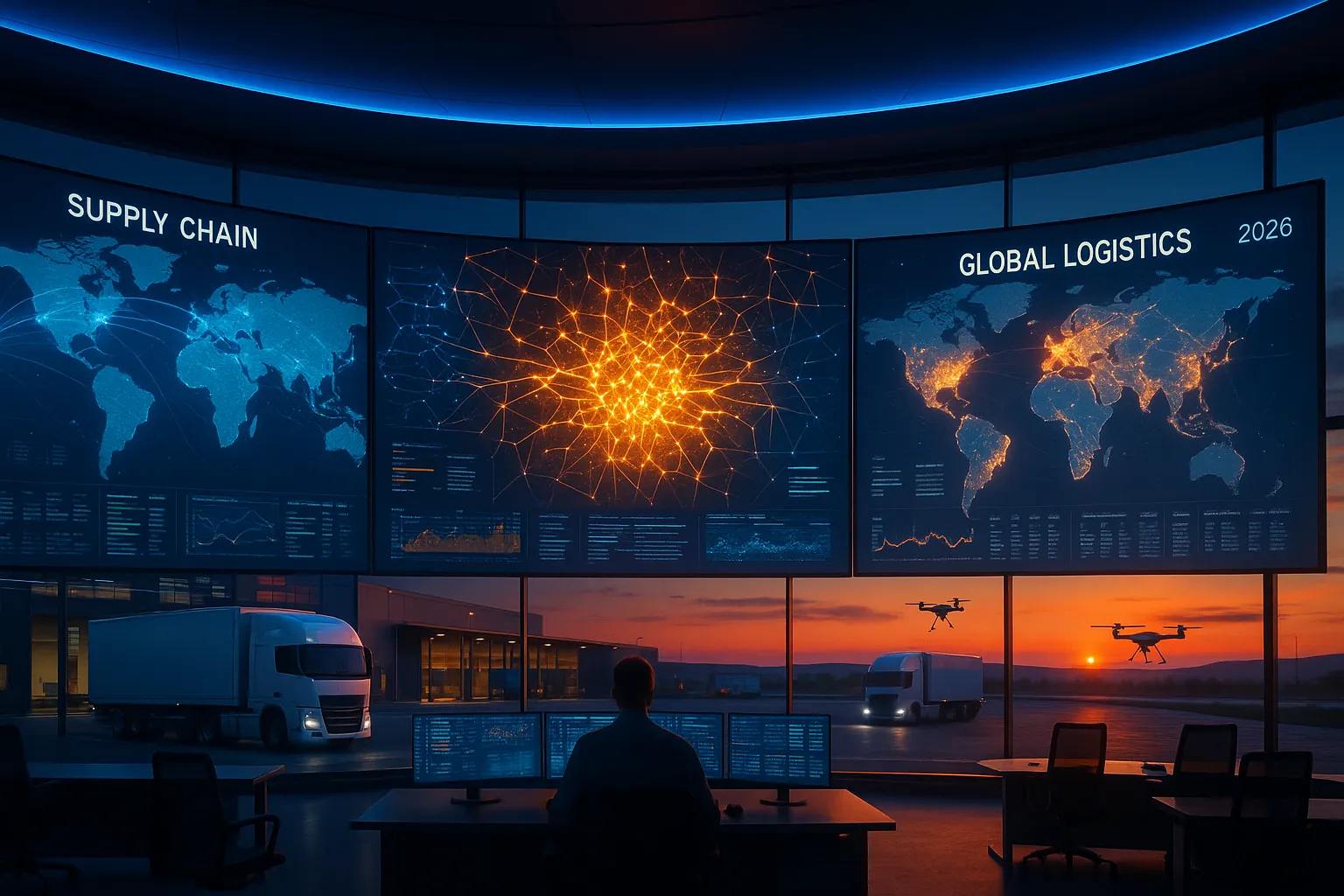
Amazon Supply Chain Services Is Turning Freight, Fulfillment, and Parcel Into One Network


Amazon’s newest logistics move is not just another parcel offering. It is a signal that the walls between freight, fulfillment, warehousing, distribution, and last-mile delivery are getting thinner for every shipper, not only for marketplace sellers.
Supply Chain Dive reported that Amazon Supply Chain Services is now open to any company, including businesses that do not sell on Amazon’s marketplace. The offering covers freight, distribution, fulfillment, and parcel delivery, with early users including 3M, Procter & Gamble, Lands’ End, and American Eagle Outfitters. The scale is the headline: more than 200 U.S. fulfillment centers, 80,000 trailers, 24,000 intermodal containers, and 100-plus aircraft.
That is not a niche 3PL product. It is an operating network being commercialized.
The service menu spans full truckload, less-than-truckload, intermodal transportation, air freight, inbound shipping from China to the United States, customs clearance, two-to-five-day parcel shipping, bulk storage, and distribution. Amazon says businesses can use one service, several services, or the full stack as needs change. For shippers, that flexibility sounds attractive. For logistics leaders, it also raises a harder question: who owns the operating truth when more of the physical network moves through one external platform?
The network is the product
Amazon has been building logistics capabilities for its own retail engine for years. Now it is packaging those capabilities as a market-facing service. FreightWaves described the launch as Amazon officially grouping its third-party logistics arms under one unified supply chain service and making excess capacity available to non-Amazon sellers.
That matters because the competitive unit is no longer a truckload rate, a warehouse contract, or a parcel label. The competitive unit is a connected network.
A manufacturer can use freight services to bring raw materials to a plant, store inventory in a distribution node, replenish fulfillment locations, and ship direct-to-consumer orders. A retailer can position inventory closer to customers and smooth peak-season demand without building every asset itself.
This is the same strategic logic that changed cloud computing: infrastructure built for internal scale becomes a service available to the broader market. In logistics, however, physical operations create exceptions constantly. Trucks arrive late. Customs entries need correction. Inventory counts drift. Parcel promises miss cutoffs. A unified network helps only if the data layer is unified too.
Outsourcing does not eliminate orchestration
The trap for shippers is assuming that handing more nodes to one provider removes the need for internal logistics control. It does not. It changes the control problem.
When freight, fulfillment, and parcel activity sit inside separate systems, the pain is obvious: teams reconcile spreadsheets, chase carrier portals, and argue over which milestone is accurate. When more of that activity sits inside one external network, the pain can become less visible but more strategic. The shipper still needs to know where inventory is, which orders are at risk, and whether customer promises remain achievable.
That requires data portability and exception visibility. If a business cannot export shipment events, inventory positions, order statuses, carrier performance, cost details, and service failures into its own operating layer, it is renting convenience, not gaining control.
The better approach is selective integration. Use external networks where they create real advantage: capacity density, peak-season flexibility, fulfillment proximity, international inbound capability, or parcel reach. But keep a system of record that can compare those services against other carriers, warehouses, brokers, forwarders, and customer commitments.
Parcel data now belongs in supply chain planning
Amazon’s move also confirms something many logistics teams already feel: parcel is no longer a downstream afterthought. It is part of supply chain network design.
Supply Chain Dive noted that Amazon says it delivers more than 13 billion items annually with a 96.4% average on-time delivery rate. Those numbers are parcel statistics, but the operational implication reaches far upstream. If a retailer wants to promise faster delivery, inventory must be positioned before the order exists. If a manufacturer wants to serve multiple sales channels, replenishment and distribution planning must account for final-mile cutoffs. If a forwarder supports omnichannel customers, freight visibility has to connect to fulfillment and delivery outcomes.
This is why the old split between “transportation management” and “order fulfillment” is breaking down. A late inbound load can become a missed parcel promise. A warehouse capacity constraint can change freight mode decisions. A customs delay can force inventory reallocation across channels. The data needs to travel across the workflow without manual translation.
Technology trends are moving toward action, not dashboards
The broader market is already pushing in this direction. Inbound Logistics described the 2026 supply chain technology landscape as moving from resilience to orchestration, with AI becoming a “system of action” rather than a standalone feature.
That is the right lens for Amazon Supply Chain Services. The story is not simply that a giant logistics network is opening to more businesses. The story is that shippers are being pushed toward connected execution models, where every freight, warehouse, parcel, and inventory signal has to support a decision.
Dashboards are not enough. A shipper needs exception queues, escalation rules, service-level monitoring, landed-cost visibility, claims documentation, and customer-facing status updates.
What shippers should evaluate before using more of the stack
Amazon’s network may be valuable for many businesses. The evaluation should still be rigorous. Logistics leaders should ask:
- Which services are actually being outsourced: freight, storage, fulfillment, delivery, customs, or all of them?
- Can shipment, inventory, order, exception, and cost data be exported into the company’s TMS, ERP, WMS, or customer portal?
- What happens when a service-level failure occurs across multiple nodes?
- Who controls carrier selection, routing rules, inventory allocation, and customer promise logic?
- Can the business compare Amazon-managed performance against alternative providers lane by lane and channel by channel?
- How portable is the data if the operating model changes later?
The point is not to avoid integrated networks. The point is to avoid becoming blind inside them.
The forwarder opportunity
For freight forwarders and logistics providers, Amazon’s move is a warning and an opening. Competing on isolated transactions will get harder. Customers will increasingly expect connected execution: one view of the order, the shipment, the inventory, the exception, and the customer promise.
That does not mean every forwarder needs Amazon-scale assets. It means forwarders need Amazon-level coordination discipline. They need systems that span modes, nodes, documents, costs, partners, and customer communications. They need to show where they add control, flexibility, compliance, and specialized service that a standardized network cannot always provide.
Amazon Supply Chain Services is turning logistics into a more integrated operating contest. The winners will not be the companies with the prettiest tracking page. They will be the companies that can turn fragmented physical movement into reliable, auditable, customer-ready execution.
CXTMS helps freight forwarders and logistics teams connect shipments, modes, documents, customers, carriers, and exceptions in one operating layer. If your network still depends on disconnected portals and after-the-fact status updates, schedule a CXTMS demo to see how orchestration can become your advantage instead of your bottleneck.