The 2,500-Space Truck Parking Opportunity: What the $200M Federal Investment Means for Freight Planning

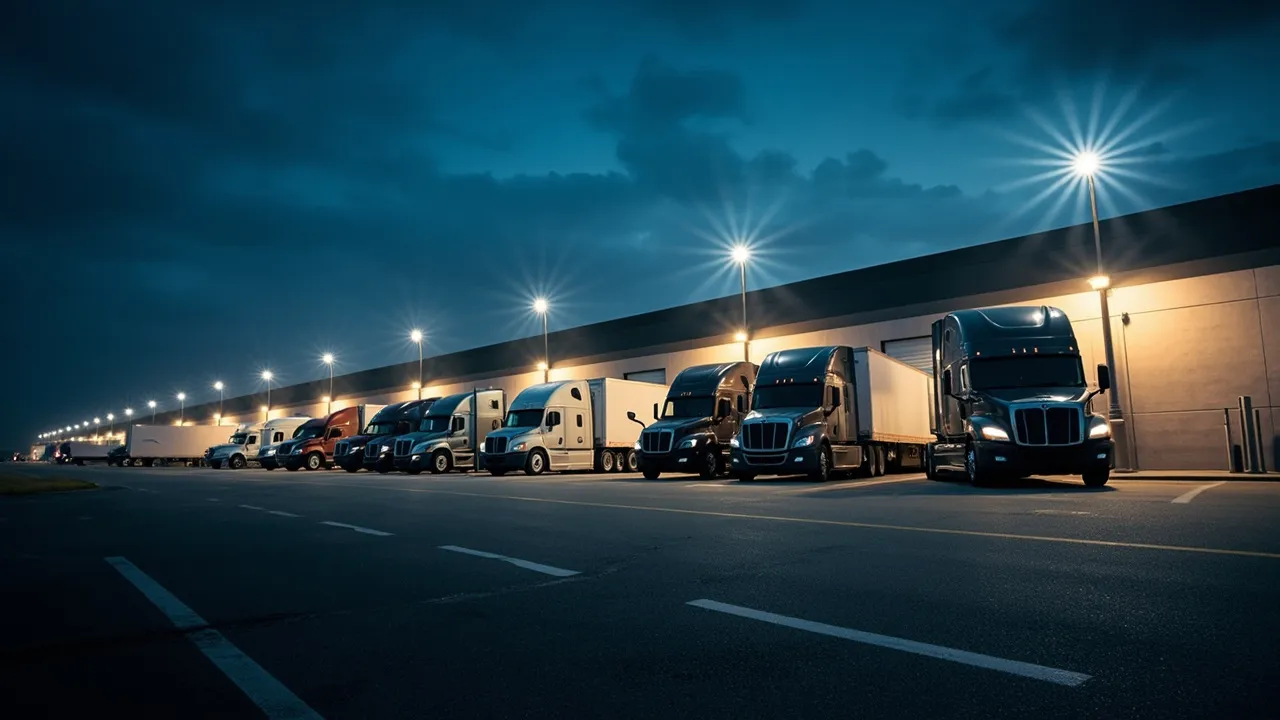
The United States is making its biggest dedicated federal commitment to truck parking in decades. For shippers, carriers, and transportation planners, the significance goes well beyond adding asphalt beside highways. Parking availability shapes how much legal driving time a carrier can use, whether a delivery appointment is realistic, and how sustainable a lane is for the people operating it.
The fiscal 2026 spending package passed by the House included a record $200 million reserved specifically for public commercial-vehicle parking. FreightWaves reported that the measure represented the first substantial congressional line item dedicated to the shortage. The legislation also restricts the money to free public truck parking near an interstate, the National Highway System, or the National Highway Freight Network.
That is a major policy shift. It is not, however, a complete solution.
Why 2,500 spaces is a useful planning benchmark
The final number of spaces will depend on land prices, site preparation, drainage, lighting, security, restrooms, and project location. If agencies achieved an all-in average of about $80,000 per space, $200 million would produce roughly 2,500 spaces. That figure should be treated as a scenario, not a confirmed government forecast.
Even at that scale, the investment would be modest relative to nationwide demand. FreightWaves cited the Owner-Operator Independent Drivers Association's estimate that there is currently only one parking space for every 11 trucks on the road. The new funding can relieve severe pressure at selected corridors, but it cannot eliminate parking risk from route planning.
The location of those spaces matters more than the headline total. A new facility that is too far from a dense freight corridor may see light use while drivers continue competing for spaces near distribution clusters. Effective projects need to sit where hours-of-service clocks, appointment schedules, and freight flows create predictable stopping demand.
Parking scarcity is a retention problem
Drivers do not experience parking shortages as an abstract infrastructure deficit. They experience them at the end of a shift, with a running electronic clock and few legal places to stop. Searching for parking consumes productive time and fuel. Parking early protects compliance but reduces miles. Continuing to search increases fatigue and the risk of an unsafe or unauthorized stop.
Those daily tradeoffs compound into dissatisfaction and turnover. Inbound Logistics has identified parking scarcity alongside low pay, long hours, compliance burdens, and unpaid waiting as conditions that push experienced drivers out. Its reporting also notes that about 400,000 new commercial driver's licenses are issued annually, reinforcing the argument that retention—not simply recruitment—is central to available capacity.
Shippers therefore have a direct interest in parking conditions. A lane that routinely leaves drivers without a safe place to complete a required rest period will be harder to cover, more expensive to price, and less attractive to experienced operators. The resulting churn can appear in transportation data as tender rejections, service failures, or higher spot-market exposure.
What makes a useful truck parking site
Capacity alone is an incomplete measure. The most operationally valuable sites combine four characteristics:
- Freight-corridor proximity. Drivers should not have to spend substantial legal driving time reaching the facility.
- Safety and basic services. Lighting, maintained pavement, restrooms, waste disposal, and clear access routes turn a parking bay into a viable rest location.
- Reliable availability information. Real-time occupancy data or reservation capability can reduce unproductive searching.
- Compatibility with route decisions. Dispatchers need the facility represented in routing and transportation-management workflows, not isolated in a separate map.
These criteria also explain why public and private capacity should work together. Federal money can expand free public parking in strategic locations, while private truck-stop networks can add services and reservable capacity. Shippers and carriers should consider both rather than assuming the public investment will remove the need for advance planning.
Four actions shippers can take now
First, incorporate likely rest stops into the route before tendering a load. A plan should account for the driver's available hours, expected congestion, appointment time, and the probability of finding parking at the planned stop. A nominally feasible transit time may not be operationally feasible once rest logistics are included.
Second, examine receiver policies. Facilities that prohibit early arrival, deny restroom access, or force drivers back onto the road after a late unload transfer parking risk to the carrier. Where space permits, staging areas and limited overnight parking can provide meaningful capacity without waiting for a large public project.
Third, use appointment flexibility strategically. A narrow delivery window that pushes a driver's stop into the evening parking peak can make an otherwise efficient lane unreliable. Adjusting an appointment by an hour may preserve more capacity than demanding an aggressive schedule and absorbing the resulting service failure.
Fourth, ask carriers where the problem is most acute. Driver and dispatcher feedback can identify recurring parking deserts before they show up as broad performance deterioration. That intelligence belongs in lane reviews and facility scorecards.
Add “driver-friendly hours” to procurement
Transportation procurement usually compares cost, on-time performance, claims, and capacity commitments. It should also evaluate whether a lane respects the driver's working day.
A practical driver-friendly hours metric could measure the share of loads whose schedules allow required breaks at viable locations without routine unpaid detention or illegal parking. Supporting measures might include average detention, after-hours restroom access, early-arrival acceptance, and the percentage of routes with an identified parking contingency.
This is not merely a social metric. It is an indicator of whether purchased capacity is durable. Lanes that consistently waste driver hours create hidden costs that eventually return through higher rates, turnover, rejected tenders, and unreliable service.
The $200 million federal investment is a welcome acknowledgment that truck parking is essential freight infrastructure. Its greatest effect will come when new spaces are paired with better site selection, real-time visibility, practical facility policies, and route plans that treat rest as a constraint rather than an afterthought.
Want to build driver-aware routes and make freight execution more predictable? Contact CXTMS to see how connected transportation planning can turn parking, appointments, and hours constraints into actionable decisions.