Smart Ports Are a $15.5 Billion Bet on the Future: How 5G and Digital Twins Are Revolutionizing Maritime Logistics

The global smart port market is on a trajectory that would have seemed like science fiction a decade ago. Valued at roughly $2 billion in 2022, the market is projected to hit $15.5 billion by 2032 — a staggering 23.1% compound annual growth rate. Behind this explosive growth is a convergence of three technologies: 5G connectivity, digital twins, and AI-driven automation. For shippers, this isn't just a port infrastructure story — it's a fundamental shift in how goods move through the most critical bottlenecks in global supply chains.
The Smart Port Market Explosion
Ports have always been chokepoints. When a vessel carrying 20,000 TEUs arrives at a congested terminal, every hour of delay ripples through supply chains, adding costs and eroding delivery promises. Traditional port operations — reliant on manual coordination, radio communication, and paper-based processes — simply can't keep pace with modern trade volumes.
The numbers tell the story. The automated container terminal market alone is valued at approximately $12.5 billion in 2026, with projections reaching $19.16 billion by 2033 at a 7.4% CAGR. But smart ports go far beyond automated cranes. They represent an entire ecosystem of interconnected technologies — from IoT sensor networks and AI-powered berth planning to blockchain-secured documentation and autonomous vehicles.
Asia-Pacific leads adoption, driven by mega-ports in China, Singapore, and South Korea that handle the lion's share of global container traffic. But European and North American ports are catching up fast, spurred by regulatory pressures like the EU's Fit-for-55 initiative and rising cyber-insurance premiums that push terminals toward secure-by-design platforms.
5G: The Nervous System of the Modern Port
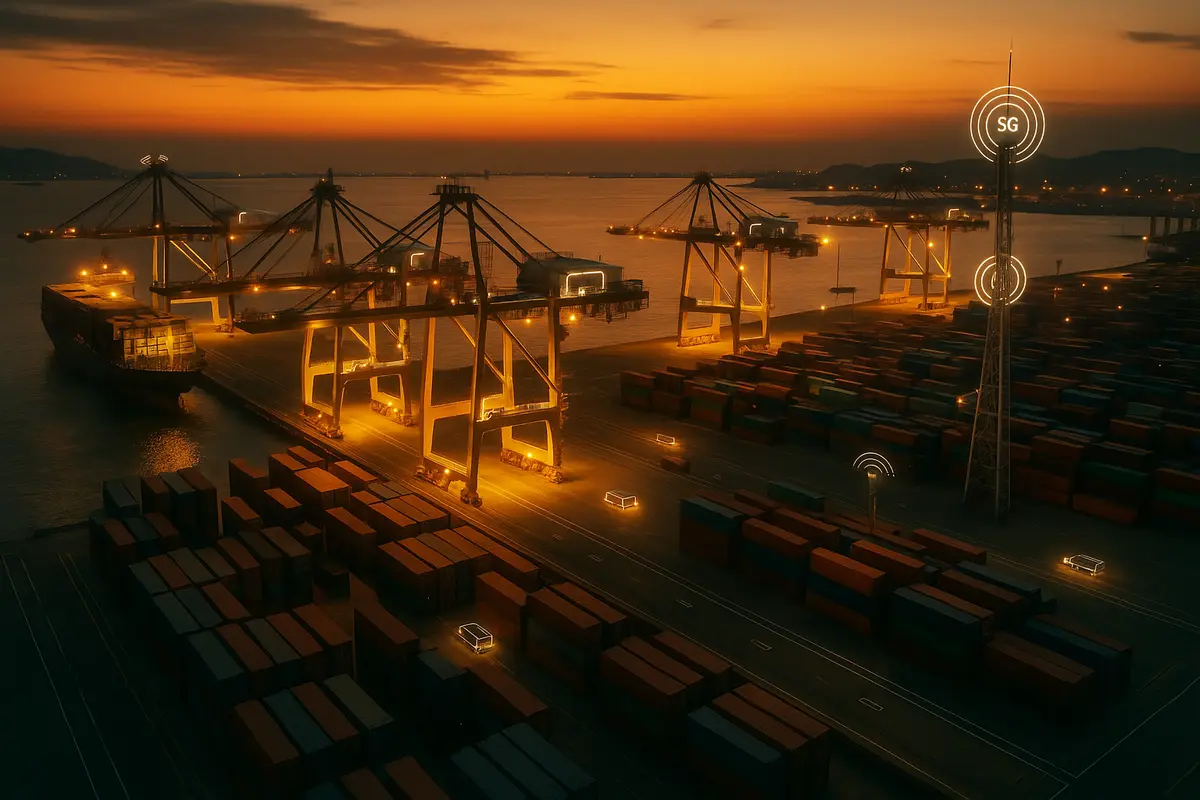
If a smart port is a living organism, 5G is its nervous system. Traditional Wi-Fi and 4G networks can't reliably support the density of connected devices a modern terminal requires — thousands of sensors, autonomous guided vehicles (AGVs), remote-controlled cranes, and wearable devices for workers, all transmitting data simultaneously.
Private 5G networks change the equation entirely. With ultra-low latency under 10 milliseconds and the ability to support up to one million connected devices per square kilometer, 5G enables operations that were previously impossible:
- Autonomous crane operations controlled remotely with real-time video feeds, eliminating the need for operators in elevated cabins
- Automated guided vehicles that navigate yard layouts with centimeter-level precision using 5G-connected positioning systems
- Real-time container tracking from arrival to departure, with every container maintaining a digital identity throughout its port journey
- Predictive equipment maintenance using continuous sensor streams that detect anomalies before failures occur
The Port of Rotterdam — Europe's largest — has been a pioneer in this space. After embedding smart logistics platforms powered by advanced connectivity, the port increased container-handling efficiency by 30% and saved an average of four hours per vessel in turnaround time. For a port handling over 14 million TEUs annually, those savings translate into billions in economic value.
Digital Twins: The Brain Behind the Operation
While 5G provides the connectivity backbone, digital twins supply the intelligence. A port digital twin is a virtual replica of the entire terminal — every berth, crane, yard block, and vessel — updated in real time with data from thousands of IoT sensors.
Digital twin platforms in the port sector are advancing at a 27.5% CAGR through 2030, making them one of the fastest-growing segments in maritime technology. The appeal is straightforward: when you can simulate every aspect of port operations in a virtual environment, you can optimize before executing.
Berth planning optimization is perhaps the most impactful application. Traditional berth allocation relies on first-come-first-served logic with manual adjustments. Digital twins analyze vessel arrival patterns, cargo types, crane availability, tide schedules, and downstream trucking capacity simultaneously — then recommend optimal berth assignments that maximize throughput across the entire terminal.
Congestion prediction is another game-changer. By modeling traffic patterns, weather impacts, and vessel schedules, digital twins can forecast congestion days before it happens. This gives terminal operators time to pre-position equipment, adjust gate hours, or redirect trucks — and gives shippers advance warning to adjust their logistics plans.
Capital expenditure optimization rounds out the value proposition. Before committing hundreds of millions to a new berth or crane purchase, port authorities can simulate the investment's impact on throughput, identify bottlenecks, and right-size their spending. This capability alone has driven rapid adoption among high-throughput ports looking to maximize returns on infrastructure investment.
What This Means for Shippers
Smart ports aren't just a technology story for terminal operators — they directly impact every shipper moving goods through maritime channels.
Faster turnaround times mean tighter, more reliable transit schedules. When ports operate predictively rather than reactively, the cascading delays that plague ocean freight diminish significantly. Shippers can plan with greater confidence, reduce safety stock, and optimize their inventory positions.
Enhanced visibility is perhaps the biggest win. Smart ports generate massive amounts of real-time data on container positions, estimated berthing times, gate processing speeds, and yard dwell times. Shippers who can integrate this data into their transportation management systems gain a level of maritime visibility that was previously unavailable.
Reduced demurrage and detention costs follow naturally. When you know exactly where your container is in the port ecosystem and can predict when it will be available for pickup, you can coordinate trucking with precision — avoiding the costly per-diem charges that erode margins.
Building Maritime Visibility Into Your TMS
The smart port revolution creates an opportunity — but only for shippers equipped to capture and act on the data these ports generate. A modern TMS like CXTMS integrates maritime data feeds, providing real-time port status, automated milestone tracking, and exception management that turns smart port data into actionable logistics intelligence.
As ports invest billions in digital infrastructure, the shippers who will benefit most are those with technology platforms capable of consuming and operationalizing that data. The gap between digitally connected shippers and those relying on manual processes will only widen as smart port adoption accelerates through the rest of this decade.
Ready to integrate smart port visibility into your logistics operations? Contact CXTMS for a demo and see how real-time maritime intelligence can transform your supply chain.