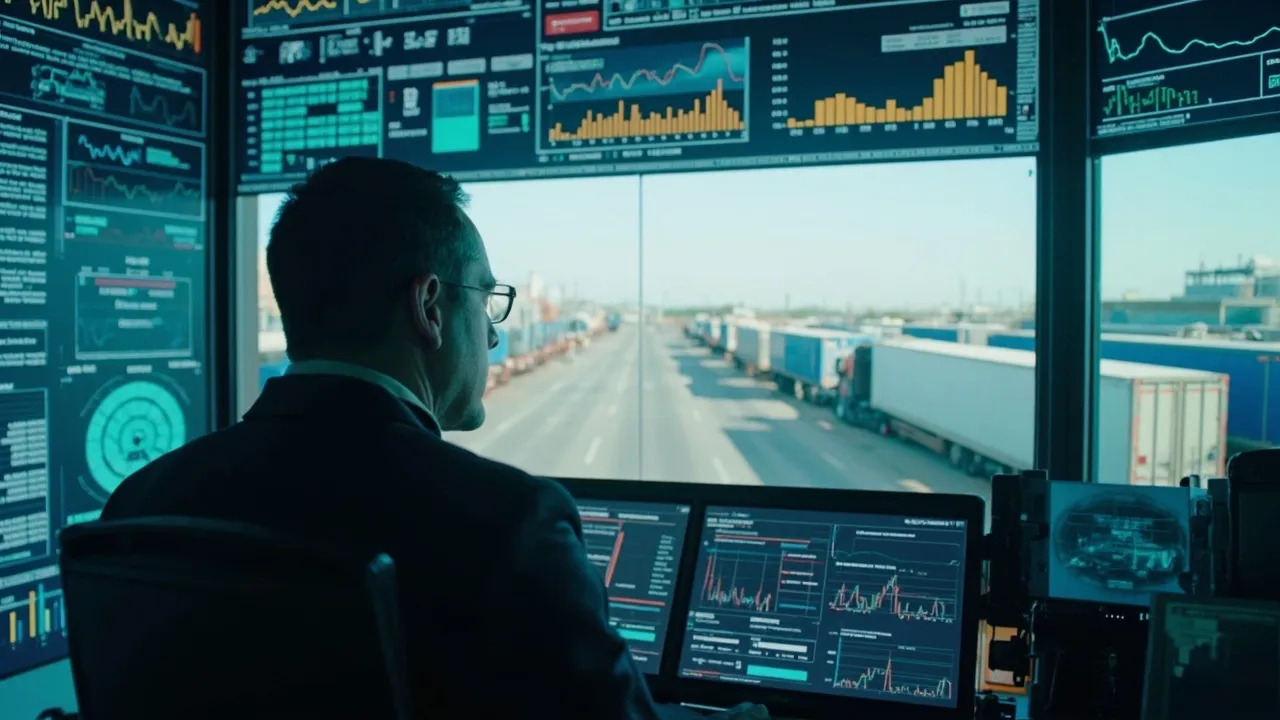
Krane Raises $9M to Deploy AI Agent Crews for Construction Supply Chain Logistics


The construction industry generates $13 trillion in annual global spending, yet its supply chains still run on spreadsheets, phone calls, and disconnected software systems. On March 25, 2026, San Francisco-based startup Krane emerged from stealth with $9 million in seed funding to change that — deploying specialized AI agent "crews" that automate the procurement, submittal management, and delivery coordination workflows that consume thousands of hours on every major build.
The round was co-led by Glasswing Ventures and Link Ventures, with participation from Tunitas Ventures, RoseCliff, and New-Normal Ventures. For an industry where productivity has grown just 1% annually over the past two decades while nearly every other sector has digitized, the investment signals a growing conviction that AI agents — not just better software — are what construction logistics actually needs.
The $13 Trillion Industry Running on Manual Coordination
Construction is one of the last major industries where supply chain coordination remains overwhelmingly manual. According to McKinsey, the sector's productivity stagnation costs the global economy an estimated $1.6 trillion annually in wasted labor, rework, and delayed projects. The root cause is not a lack of ambition — it is a structural fragmentation problem.
A typical large-scale construction project involves hundreds of suppliers, thousands of material line items, and dozens of interconnected schedules managed across an average of 10 or more disconnected systems. Project engineers spend 15 to 20 hours per week on procurement coordination alone — parsing drawings for material specs, generating procurement logs, chasing supplier quotes, tracking submittals, and manually reconciling delivery schedules with project timelines.
When a single material delivery slips, the cascade effect is brutal. Idle labor crews, missed milestones, and cost overruns compound quickly. On large data center builds, delays can cost millions of dollars per day in lost productivity and penalty clauses.
AI Agent Crews: Milo, Theo, and the Digital Operations Team
What sets Krane apart from traditional construction management software is its agentic AI architecture. Rather than providing dashboards that humans must interpret and act on, Krane deploys specialized AI agents that autonomously execute discrete supply chain workflows.
The platform's AI agents handle specific operational functions:
-
Procurement automation: Agents ingest project drawings, specifications, and schedules, then automatically generate procurement logs, link material requirements to construction timelines, and create purchase orders — work that previously required project engineers to manually cross-reference dozens of documents.
-
Submittal management: AI agents create and validate submittal packages, compare supplier quotes, and generate requests for proposals. Each workflow ties back to Krane's centralized data model, ensuring that updates propagate across the entire system in real time.
-
Delivery coordination: Agents coordinate with suppliers to validate lead times, track shipments, automate delivery scheduling, and generate predictive alerts when materials are at risk of arriving late.
-
Quote management: The platform automates the RFP process, comparing supplier quotes across multiple dimensions and flagging discrepancies before they become costly change orders.
This "crew" model mirrors how AI agents are being deployed in freight logistics — but adapted for construction's unique complexity. Instead of optimizing truck routes, Krane's agents optimize the flow of steel, concrete, electrical equipment, and mechanical systems across multi-year build schedules.
Data Centers: The Killer Use Case
Krane's timing is not accidental. The data center construction boom — driven by AI infrastructure demand — has created unprecedented urgency around supply chain efficiency. Capital expenditures on data center construction are projected to approach $100 billion in 2026 as hyperscalers like Meta, Microsoft, and Google race to build gigawatt-scale facilities.
Data centers represent a perfect proving ground for AI-driven construction logistics:
- Materials complexity: A single hyperscale data center requires thousands of unique components — from specialized cooling systems and power distribution units to fiber optic cabling and structural steel — each with different lead times and supplier networks.
- Compressed timelines: The competitive pressure to bring AI compute capacity online means projects that once had 24-month timelines are being pushed to 12-18 months, leaving zero margin for supply chain errors.
- Integration requirements: Data center builders already use platforms like Autodesk, Procore, Microsoft Project, and Oracle Primavera P6. Krane integrates with all of these, layering AI coordination on top of existing workflows rather than requiring a full technology overhaul.
According to Krane, companies using its platform report 10x faster response times from subcontractors and suppliers, 1-2.5% reduction in material overspend per project, and 15-20 hours saved per week for project engineers and project managers.
"Construction supply chain processes were never designed to support the scale and pace of today's growing industry," said Krane CEO Eshan Jayamanne, a licensed professional engineer with experience in large-scale infrastructure projects. "We built Krane to shift that burden off field teams, using an AI-driven construction operations team to handle the heavy lifting behind the scenes."
What Construction Can Learn From Freight Logistics
The parallels between construction supply chain chaos and the challenges freight logistics faced a decade ago are striking. Both industries suffered from fragmented data, manual coordination, and a resistance to technology adoption. Both relied heavily on phone calls and spreadsheets to manage complex, time-sensitive operations.
Freight logistics solved these problems through centralized visibility platforms, AI-powered optimization, and real-time data integration — exactly the approach Krane is bringing to construction. The lessons are clear:
- Centralization wins: Consolidating supply chain data into a single source of truth eliminates the coordination overhead that causes most delays.
- AI agents outperform dashboards: Providing teams with information is not enough — autonomous agents that execute workflows deliver measurably better outcomes.
- Integration beats replacement: The most successful logistics platforms work alongside existing tools rather than forcing wholesale technology changes.
As Glasswing Ventures Managing Director Kleida Martiro noted: "With margins under pressure and supply chains increasingly complex, operators need real-time intelligence to protect profitability and keep projects on track."
The Bigger Picture: Vertical AI Is Winning
Krane's emergence reflects a broader industry trend: vertical-specific AI solutions are outperforming horizontal platforms. Just as freight logistics, healthcare, and financial services have seen purpose-built AI tools outcompete generic enterprise software, construction is following the same trajectory.
The $13 trillion construction industry — projected to grow to $22 trillion by 2040 — represents one of the largest untapped markets for AI-driven supply chain automation. With $9 million in seed funding and early traction across data center, healthcare, education, and biotechnology facility projects, Krane is positioning itself as the platform that finally brings construction logistics into the era of autonomous operations.
For logistics operators watching from the freight and warehousing side, the message is clear: the AI agent model that is transforming transportation management is now spreading to adjacent verticals — and the companies that master cross-industry supply chain intelligence will have a decisive advantage.
Ready to bring AI-powered supply chain intelligence to your logistics operations? CXTMS delivers the same centralized visibility, AI-driven optimization, and real-time coordination that construction is just beginning to adopt — purpose-built for freight and transportation management. Request a demo today and see how autonomous supply chain operations can transform your business.