Blockchain in Logistics Makes a Comeback: How Distributed Ledger Technology Is Solving Trade Finance and Document Verification in 2026


Blockchain in logistics is no longer a buzzword chasing venture capital. After the collapse of TradeLens in 2022 and a period of industry skepticism, distributed ledger technology is making a pragmatic comeback — this time focused on solving two of global trade's most persistent pain points: trade finance settlement and document verification.
From Hype to Infrastructure: Why 2026 Is Different
The blockchain logistics hype cycle of 2018–2020 promised everything and delivered mostly pilot programs. TradeLens, the Maersk-IBM joint venture, shut down in late 2022 after failing to achieve industry-wide adoption. The lesson wasn't that blockchain didn't work — it was that consortium-driven platforms controlled by competitors were doomed from the start.
The 2026 landscape looks fundamentally different. The blockchain supply chain market is valued at $1.77 billion in 2026 and projected to reach $12.41 billion by 2031, growing at a staggering 47.65% CAGR.
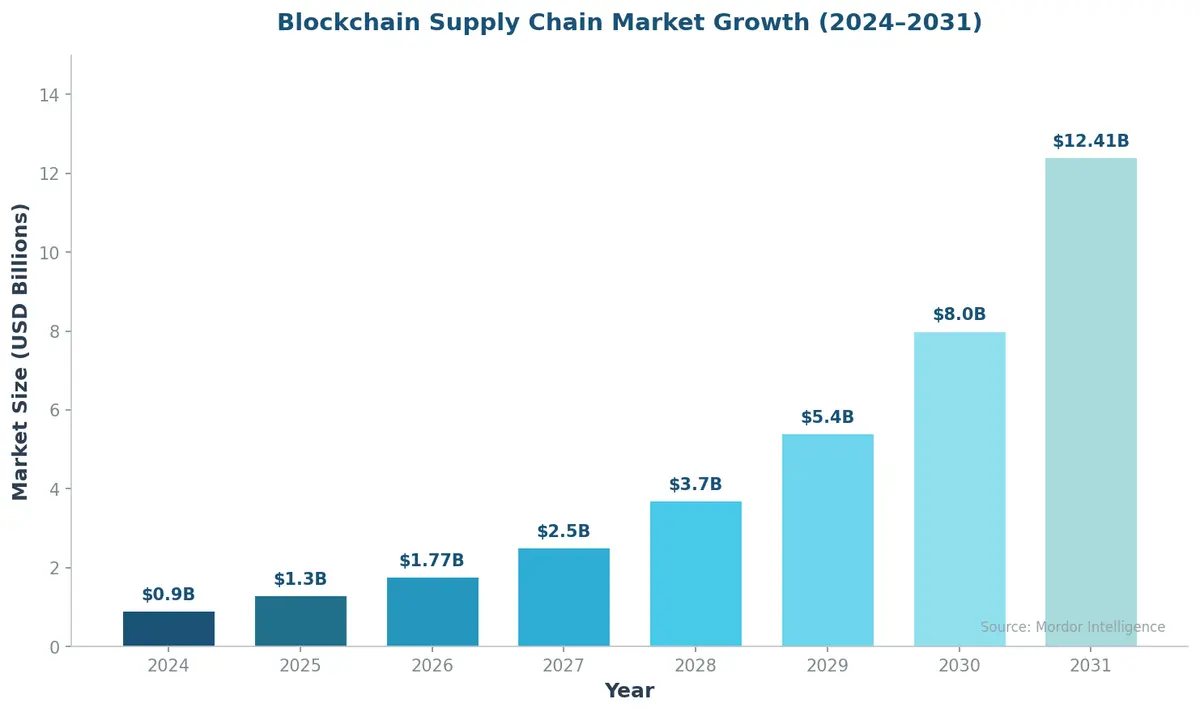
What changed? Three things: legal frameworks caught up, interoperability standards matured, and the use cases narrowed to where blockchain actually adds irreplaceable value.
The Electronic Bill of Lading Revolution
Of the roughly 45 million bills of lading issued annually in container shipping, the vast majority are still processed on paper — physically couriered between ports, banks, and trading partners. According to the Digital Container Shipping Association (DCSA), only about 5.7% of container bills of lading were issued electronically as of early 2025. That number is rising fast.
DCSA's nine member carriers — representing over 70% of global container capacity — have committed to 100% electronic bill of lading (eBL) adoption by 2030. In May 2025, DCSA completed its first successful standards-based, interoperable eBL transaction, a milestone that addressed the platform fragmentation problem that killed earlier efforts.
Blockchain is the enabling layer that makes eBL trustworthy at scale. A distributed ledger ensures that:
- Only one party holds the original document at any time (solving the "double-spend" problem for trade documents)
- Ownership transfers are immutable and auditable, eliminating disputes over document authenticity
- No single platform controls the record, avoiding the TradeLens centralization trap
Trade Finance: From 90-Day Waits to Near-Instant Settlement
Global trade finance is a $5.2 trillion market where letters of credit, bills of lading, and certificates of origin still move at the speed of paper. The blockchain in supply chain finance market was valued at $1.17 billion in 2024 and is projected to reach $2.30 billion by 2032, driven by the urgent need for transparency and fraud prevention.
Here's what blockchain changes in trade finance:
Digital Letters of Credit. Traditional letters of credit involve 5–7 intermediaries and take 5–10 business days to process. Blockchain-based letters of credit on platforms like Contour and TradeFinex reduce this to hours by automating document matching, compliance checks, and settlement triggers through smart contracts.
Instant Payment Triggers. Smart contracts can release payment automatically when IoT sensors confirm cargo delivery at the specified location, eliminating the manual reconciliation process that typically delays settlement by 30–90 days.
Fraud Prevention. The ICC estimates that trade finance fraud costs the industry billions annually. Tamper-proof blockchain records of certificates of origin, inspection certificates, and shipping documents make document forgery functionally impossible.
Legal Frameworks Finally Catch Up
One of the biggest barriers to blockchain adoption in trade was legal recognition. A digital document was only as good as the law that recognized it. That's now changing rapidly.
The UK Electronic Trade Documents Act, which came into force in September 2023, gives electronic trade documents — including bills of lading, warehouse receipts, and bills of exchange — the same legal standing as their paper equivalents. This legislation is based on UNCITRAL's Model Law on Electronic Transferable Records (MLETR), which provides a framework for countries worldwide.
A Commonwealth report predicts that trade digitalization could increase trade by $1.2 trillion by 2026. As more countries adopt MLETR-aligned legislation — Singapore, Bahrain, Abu Dhabi, and Paraguay have already done so — the legal foundation for blockchain-verified trade documents becomes global.
New Consortium Approaches: Lessons From TradeLens
The post-TradeLens era is defined by open standards over proprietary platforms. DCSA's approach — publishing open-source APIs that any platform can implement — avoids the fatal flaw of asking competitors to join a single platform.
Key principles driving successful blockchain logistics deployments in 2026:
- Interoperability first. Multiple eBL platforms (WaveBL, CargoX, Bolero, edoxOnline) can now exchange documents across platforms using DCSA standards
- Utility, not speculation. Enterprise blockchain deployments use permissioned ledgers focused on business processes, not cryptocurrency tokenomics
- Incremental adoption. Rather than replacing all trade documents at once, successful deployments start with high-value, high-friction documents like bills of lading and letters of credit
- Neutral governance. Standards bodies like DCSA and BIMCO provide neutral ground that no single carrier or tech vendor controls
What This Means for Shippers and Freight Forwarders
For logistics operators evaluating blockchain readiness, the practical implications are clear:
- eBL adoption is inevitable, not optional. With major carriers pushing toward 100% digital by 2030, paper-dependent processes will become competitive liabilities
- Trade finance costs will drop significantly for early adopters who can offer blockchain-verified documentation to banks, reducing letter of credit processing fees and accelerating cash flow
- Document compliance becomes automated — certificates of origin, dangerous goods declarations, and customs documentation can be verified in real time against immutable records
- TMS integration is the bridge between blockchain infrastructure and day-to-day logistics operations, connecting document workflows to shipment execution
How CXTMS Supports the Digital Document Future
Modern TMS platforms must be ready for the blockchain-enabled document ecosystem. CXTMS is built with API-first architecture that connects to eBL platforms, customs systems, and trade finance networks — ensuring that as blockchain-verified documents become standard, your logistics operations are ready to process them seamlessly.
From automated document generation to real-time compliance verification, CXTMS provides the orchestration layer that makes digital trade documents actionable within your supply chain workflows.
Ready to future-proof your trade documentation? Contact CXTMS for a demo of our digital document management capabilities.