Physical AI in Warehouses Needs a Shared Safety State Across Robots, Conveyors, and People

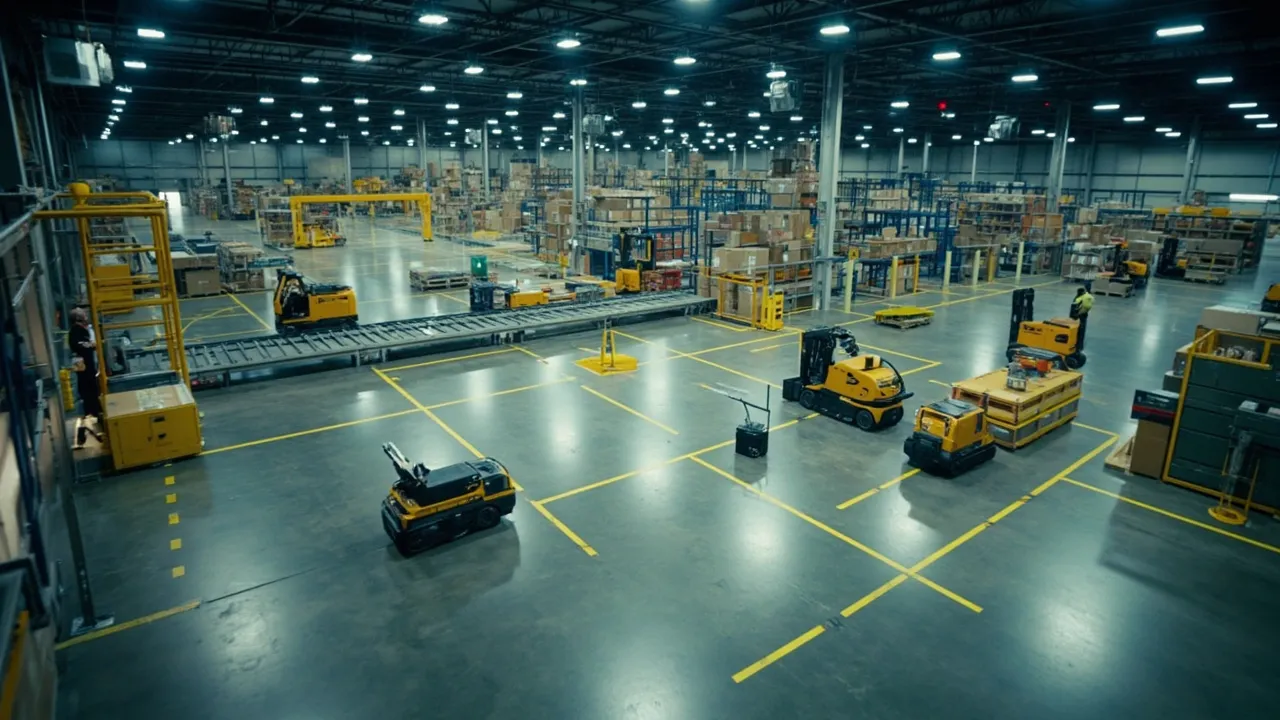
Warehouse automation is becoming less like a collection of machines and more like a coordinated workforce. Autonomous mobile robots route around congestion, vision systems identify objects, conveyors regulate flow, and software changes priorities as orders arrive. That combination of perception, decision-making, and physical movement is physical AI.
The opportunity is substantial, but so is the coordination problem. Modern Materials Handling reported in its 2025 industry outlook that about 10% of companies were using automated guided vehicles or autonomous mobile robots, while 30% planned to evaluate them within one or two years. As adoption expands, safety cannot remain a feature managed independently by each machine. A warehouse needs a shared safety state: a common, current view of where equipment and people may move, which assets are available, and which conditions require every connected system to slow, stop, or reroute.
Physical AI Changes the Unit of Safety
Traditional automation often protects a fixed machine with guarding, light curtains, interlocks, and tightly defined operating envelopes. Physical AI introduces mobile equipment and decisions that change with the environment. An AMR may select a new route, a robotic arm may handle an unfamiliar carton, or a conveyor may divert volume after a downstream fault.
Modern Materials Handling's overview of robotics, AI, and warehouse orchestration notes that AMRs use AI for safe navigation and fleet management. That protects the robot's immediate movement, but local navigation is only one layer. An AMR can avoid a person and still route into a lift-truck aisle that has just become congested. A conveyor can stop safely while leaving cartons blocking an emergency path. Every subsystem can behave correctly in isolation while the facility enters an unsafe state.
The unit of safety therefore has to expand from an individual asset to the operating area and the work being performed within it.
Handoffs Create the Highest-Risk Moments
Risk concentrates where control passes between systems. Consider a pallet traveling from conveyor to AMR, from AMR to staging, and from staging to a lift truck. Each step may use different sensors, identifiers, traffic rules, and stop logic.
Four gaps deserve particular attention:
- Conflicting right-of-way rules: AMRs, forklifts, and pedestrians may interpret crossings differently.
- Incomplete load state: One system may report a transfer complete before the load is stable or the receiving position is clear.
- Delayed fault propagation: A jam, sensor failure, or emergency stop may not reach upstream equipment quickly enough.
- Maintenance ambiguity: Software may continue assigning work to an aisle or asset that technicians have isolated locally.
MHI's guidance on implementing robotics in the modern supply chain emphasizes unified data, real-time equipment visibility, and configuration that supports safe operation alongside people. The practical implication is clear: integration must include safety-relevant operating state, not merely inventory and task messages.
Build a Shared Safety State
A shared safety state is not a replacement for certified machine controls or physical safeguards. It is a coordination layer that gives connected systems the same operational picture and defines conservative behavior when information is missing.
Start with four state categories.
Zone state should identify whether an aisle, crossing, dock approach, work cell, or pedestrian area is open, restricted, speed-limited, or stopped. Every change needs an owner, timestamp, reason, and expiration rule.
Congestion state should combine traffic density, queue length, blocked-path signals, and human activity. Thresholds can progressively reduce robot speed, pause releases from upstream conveyors, or direct lift trucks to alternate routes before gridlock forms.
Maintenance state should distinguish available, degraded, under inspection, locked out, and cleared for testing. The state must flow from the maintenance control to task assignment and traffic orchestration so that a repaired machine is not returned to production prematurely.
Emergency state must define how local stops affect adjacent systems. A pressed emergency stop may require an immediate halt in one cell, a controlled stop upstream, and a traffic exclusion zone around the incident. Reset authority and restart sequence should be explicit; no subsystem should infer that another system's reset means the entire area is safe.
Use a common event model with asset and zone identifiers, synchronized timestamps, message priority, acknowledgement, and fail-safe timeouts. If a system stops receiving trustworthy state updates, it should enter a predefined reduced-speed or stopped condition rather than assume the last status remains valid.
Pilot Autonomy With Safety and Recovery Metrics
Warehouse leaders should test physical AI in a bounded zone before extending it facility-wide. Choose a process with visible handoffs, measurable flow, and a workable manual fallback. Document baseline throughput and safety performance, then run normal, peak, degraded, and emergency scenarios.
Track a balanced scorecard:
- Throughput per labor hour and completed moves per hour
- Human interventions per 100 autonomous tasks
- Near-miss events by zone, asset type, and handoff
- Time from hazard detection to coordinated safe state
- Recovery time from stop to verified restart
- False stops and lost production minutes
Throughput alone can reward aggressive routing. Stop counts alone can reward excessive caution. The useful measure is safe productive flow: how consistently the operation completes work while detecting conflicts early and recovering in a controlled way.
Autonomy Depends on Shared Context
Physical AI will not produce an autonomous warehouse simply because individual robots become more capable. The facility becomes autonomous when equipment can coordinate around the same constraints, people can understand and override that coordination, and every system fails predictably when context is uncertain.
A shared safety state makes that possible. It connects zones, congestion, maintenance isolation, and emergency response into one operational language. With that foundation, warehouse teams can scale automation without turning every new robot, conveyor, or control platform into another safety silo.
Ready to connect warehouse execution with dependable transportation planning? Request a CXTMS demo to see how unified logistics data can improve shipment visibility, exception control, and coordination across your network.