Lowe's Drone Delivery Pilot: Build a Store-Level Flight Eligibility Gate

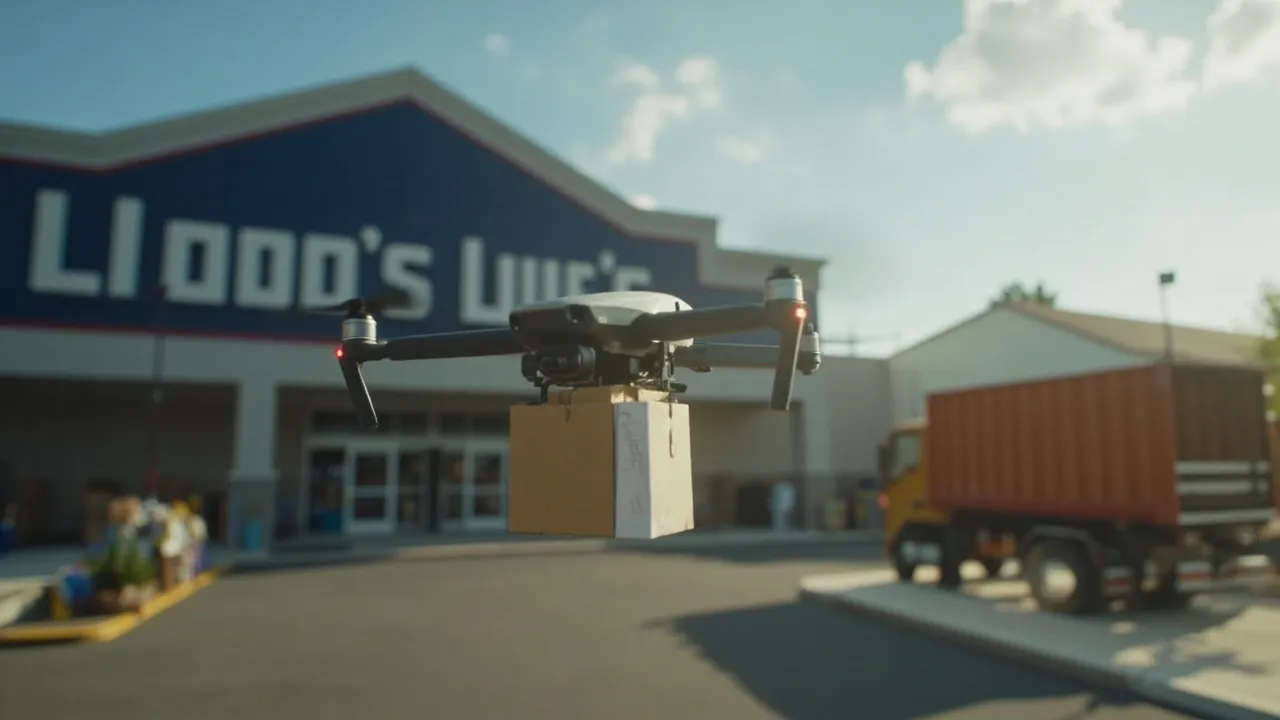
Drone delivery is moving from a novelty to a real fulfillment option for small, urgent retail orders. Lowe's new pilot with Wing and DoorDash is a useful example: the promise is not merely faster transportation, but the ability to send a forgotten screwdriver, tape measure, or box of fasteners from a local store while a home-improvement job is still underway.
That promise creates a new operational question. A retailer cannot offer drone delivery simply because the customer's address falls inside a circle on a map. Every order must pass a store-level eligibility gate that combines product, inventory, weather, airspace, destination, and service constraints. If one check fails, the order should move to another mode without becoming a new order or losing its history.
The pilot defines a narrow but valuable use case
Supply Chain Dive reports that Wing drones in the Lowe's pilot can carry orders weighing about 2.5 pounds per flight. More than 100 SKUs are eligible, with deliveries available in as little as 20 minutes from the store. The program is launching through select stores in the Dallas-Fort Worth area, beginning in the Dallas suburb of Frisco.
Those numbers clarify the opportunity. A 2.5-pound payload will not replace a pickup truck loaded with lumber or appliances. It can, however, serve the lightweight item that prevents a customer or contractor from completing a task. Speed has unusually high value when the alternative is stopping work, driving back to a store, finding the item, and returning to the site.
The product mix also fits broader industry experience. Inbound Logistics notes that drone delivery is best suited to ultra-fast movement of single packages such as lightweight consumer goods, food, and medical prescriptions. The correct operating model is therefore selective. Drone should be offered only where its constraints and the customer's urgency intersect.
Build the eligibility gate before checkout
The delivery promise should appear only after a sequence of machine-readable checks. Running them after payment creates substitutions, cancellations, and service recovery work that erode the value of a 20-minute proposition.
Order and product: Calculate packed weight, not catalog weight. Include packaging, protective material, and any carrier fixture. Confirm that every SKU is approved for aerial transport and that dimensions, fragility, liquids, batteries, sharp edges, and hazardous-material rules are satisfied. A multi-item basket may be individually eligible but too heavy when combined.
Store inventory: Reserve a specific sellable unit at the serving store before offering the mode. Inventory must be in an accessible pick location with enough remaining shelf life or condition quality. The system should account for competing store demand and avoid promising the last unit when inventory confidence is poor.
Flight conditions: Check current and forecast wind, precipitation, temperature, visibility, and any operator-specific thresholds for the expected flight window. A weather check made when the cart opens is stale by dispatch; revalidate before tendering the flight.
Airspace and route: Confirm that the origin, destination, and complete flight path are serviceable. Temporary restrictions, local operating boundaries, obstacles, and route-specific range matter more than straight-line distance. The route check should return a reason code rather than a generic “unavailable” result.
Customer site: Validate a precise delivery point with sufficient clearance and a supported handoff method. Apartments, tree cover, power lines, construction activity, pets, or an obstructed yard can make an otherwise eligible address unsuitable. Customers should confirm that the drop area will remain clear.
Operational capacity: An eligible flight is not necessarily an available flight. Check aircraft, battery, operator, loading position, and store labor capacity against the promised window. The system should stop offering the mode when the dispatch queue can no longer support the commitment.
Preserve one order when the mode changes
Drone operations will encounter weather holds, inventory discrepancies, customer-site problems, and capacity limits. The recovery design matters as much as the aircraft. Creating a replacement order for courier or parcel service fragments payment, inventory, customer communication, and performance reporting.
Instead, preserve a single commercial order and attach successive fulfillment plans to it. The order record should retain the original promise, selected mode, quoted charge, reserved inventory, eligibility results, and customer instructions. Each attempted plan—drone, local courier, pickup, or parcel—should have its own tender, milestones, cost, failure reason, and revised delivery commitment.
When a drone plan fails, apply a preapproved recovery hierarchy. An urgent local order may move first to same-day courier, then customer pickup. A less urgent order may shift to parcel. Reconfirm the new promise and any price difference before dispatch when the substitution changes what the customer purchased. Automated notifications should explain the outcome plainly without exposing aviation jargon.
This structure also prevents a misleading success rate. If the drone leg is canceled but a courier completes the delivery, the customer order succeeded while the drone plan did not. Both facts belong in the record.
Measure successful deliveries, not impressive launches
A pilot scorecard should begin with the percentage of orders shown the drone option, the percentage selected, and the percentage completed by drone within promise. Break eligibility failures and post-selection failures into reason codes: weight, SKU restriction, inventory, weather, airspace, site, capacity, customer cancellation, or technical exception.
Then track business outcomes:
- Cost per successful delivery: Include picking, packing, loading, flight operations, support, failed attempts, and recovery—not only aircraft operating cost.
- Mode substitution rate: Measure how often selected drone orders shift to courier, pickup, or parcel and why.
- Promise attainment: Compare the original and revised promises with actual delivery time.
- Customer recovery: Track contacts, refunds, credits, cancellations, and satisfaction after exceptions.
- Inventory accuracy: Measure substitutions and cancellations caused by unavailable or unsuitable store stock.
- Incremental value: Separate truly incremental orders from demand that merely moved from pickup or another delivery mode.
Review results by store, hour, weather band, SKU, route, and destination type. A network average can hide a store whose inventory accuracy undermines the service or a neighborhood where site failures recur.
Make the gate reusable
Drone delivery will remain one option inside a broader last-mile portfolio. The durable capability is a rules-driven mode decision that can evaluate an order, explain its choice, and recover without losing continuity. That same discipline improves courier, parcel, pickup, and future autonomous delivery services.
CXTMS gives logistics teams one place to coordinate orders, modes, milestones, costs, and exceptions as new delivery options enter the network. Request a CXTMS demo to see how configurable transportation workflows can support faster fulfillment without sacrificing operational control.