Autonomous Trailer Unloading: Measure Door-Cycle Recovery Before Automating the Dock

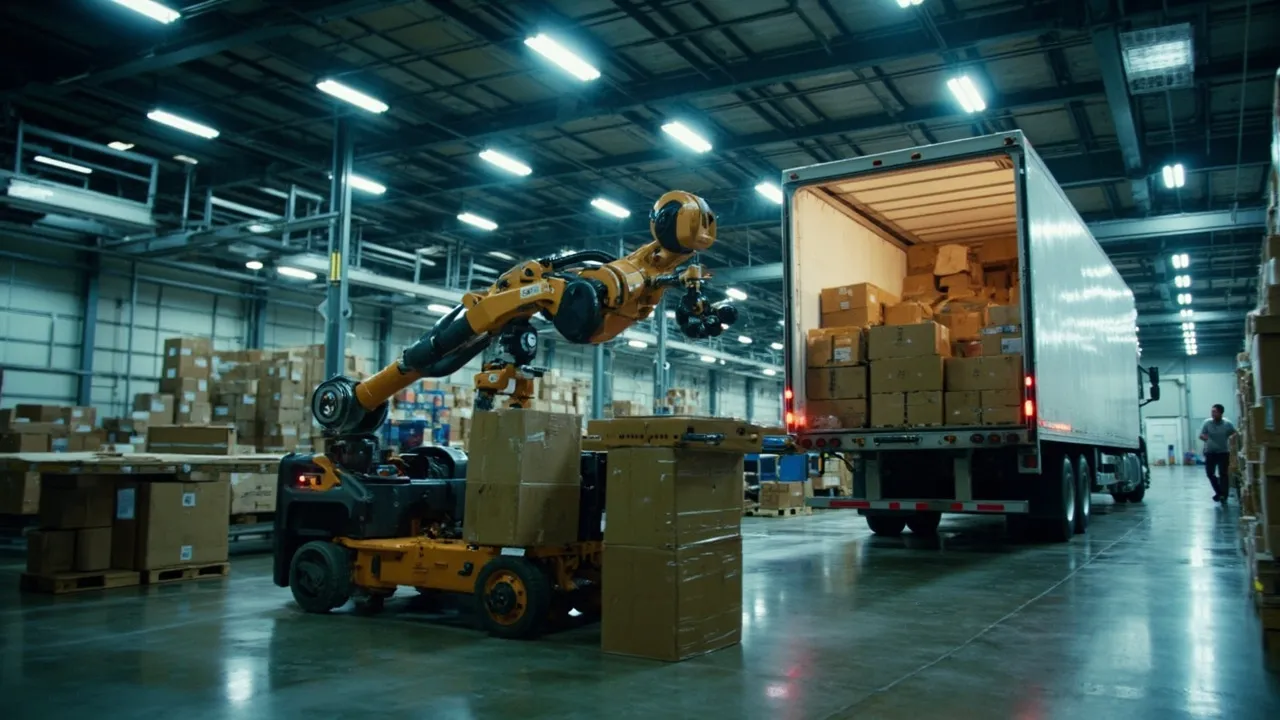
Autonomous trailer unloading promises to remove one of the warehouse's hardest, hottest, and most variable jobs. Yet a robot's advertised cases-per-hour rate does not tell an operator whether a dock door will become available sooner. That distinction matters: the economic unit is not a robotic pick. It is a completed trailer cycle that releases the door, labor, and downstream capacity for the next appointment.
The right buying question is therefore not “How fast can the robot pick?” It is “How reliably can this operation recover the door across the freight we actually receive?”
Why the trailer remains difficult to automate
Automation performs best when products, presentation, and movement are predictable. A floor-loaded trailer supplies none of those guarantees. Cartons may be crushed, leaning, taped irregularly, or hidden behind a collapsed wall. Loads can combine small cases with heavy or deformable packages. Trailer floors, walls, lighting, and clearances also vary.
These conditions explain why unloading has remained manual even as conveyors, sortation, storage, and picking matured. Inbound Logistics notes that every trailer and pallet load is different, while advances in machine vision, robotics, and AI are only now making more of the process automatable.
The work is also a safety target. Inbound Logistics reports that 25% of reported warehouse injuries occur on loading docks. Moving repetitive lifting out of a hot or cold trailer can improve the job even when an operator still supervises exceptions.
Segment the freight before comparing systems
Averages conceal the conditions that determine performance. Build the business case around representative load profiles:
- Uniform floor-loaded cartons: Consistent corrugate and stable walls are usually the most automation-friendly profile.
- Mixed cases: Changes in size, weight, surface, and orientation test perception, gripping, and placement logic.
- Damaged freight: Crushed corners, open flaps, leaks, and unstable stacks create recovery work and potential claims.
- Trailer geometry: Door width, floor condition, wall deformation, lighting, and the gap between trailer and dock affect access and navigation.
Record the percentage of inbound trailers in each segment and test each one. Do not let a clean demonstration load stand in for the actual vendor and lane mix. If a system performs well on uniform parcel freight but requires frequent assistance on mixed retail cases, its blended operating result may be very different from its peak rate.
Published throughput illustrates the range. A 2026 Modern Materials Handling dock equipment report says AI-powered unloading robots can handle 400 to 1,500 cases per hour, depending on freight, compared with a typical human rate of 50 to 300 cases per hour under varying conditions. Supply Chain Dive previously reported an expected 800 cases per hour for one robotic unloader. These are useful reference points, but the spread itself is the warning: freight conditions govern the result.
Make door-cycle time the primary measure
Define the cycle from the first operational timestamp to the last. For an inbound trailer, that might begin when the trailer is secured at the door and end when it is empty, exceptions are cleared, freight has entered the next process, and the door is ready for another move.
Measure at least five dimensions:
- Door-cycle time: Median and 90th-percentile minutes by freight segment, not just a daily average.
- Human interventions: Number, duration, and reason for every stop that requires a person to enter or reset the process.
- Exception recovery: Time from detection to resumed autonomous work, including damaged cartons and unpickable items.
- Damage: Cases damaged during handling, plus damage discovered and correctly diverted.
- Downstream induction: Whether cartons leave the unloader at a pace the conveyor, scan tunnel, palletizing cell, or receiving team can absorb.
The tail matters. A fast median paired with a long 90th percentile can disrupt appointment schedules and yard flow. Recovery should also be separated into assisted and unassisted events. A robot that pauses safely is doing one part of its job; a process that leaves it idle for 18 minutes awaiting an authorized operator is still consuming the dock door.
Count the full cycle, not isolated labor savings
Suppose a robot removes cartons twice as fast as the prior crew, but downstream induction fills and forces repeated stops. Direct unloading labor falls, yet the trailer remains at the door nearly as long. The site may also move labor from inside the trailer to exception handling, pallet building, or congestion control. That can still be a safety win, but it is not the same as a capacity win.
This is why system trials need a control group. Compare similar trailers, shifts, and product profiles under manual and automated operation. Include setup, repositioning, battery or charging events, resets, cleanup, and handoff. Track productive autonomous time as a share of scheduled door time.
The opportunity can be substantial when the application fits. Modern Materials Handling reported a deployment that accelerated loading and unloading sixfold at an Indiana site. Another industry example involved a $15 million commitment to deploy mobile unloading robots across multiple facilities. Those figures show the scale of interest, but neither substitutes for a site-specific recovery model.
Connect WMS and TMS timestamps
The automation layer should not keep its own isolated version of performance. Connect robot events to warehouse and transportation records so the operation can reconstruct the entire visit.
The TMS should provide appointment, gate-in, yard move, dock assignment, and departure timestamps. The WMS should capture receiving start, carton induction, inventory receipt, exception disposition, and completion. The robotic system should add autonomous start and stop times, intervention codes, carton counts, and fault events.
With those events aligned, managers can see whether faster unloading reduces driver dwell, frees doors, and advances inventory availability—or merely pushes a queue to receiving. They can also compare carriers, origins, suppliers, and load-building practices. A recurring crushed-carton exception may be a supplier packaging problem rather than a robot problem.
Set a door-recovery acceptance test
Before purchase, agree on an acceptance test using real freight and a defined sample size. Set thresholds for median and 90th-percentile door-cycle time, autonomous completion rate, interventions per 1,000 cases, damage, and downstream blockage. Require results by load segment and shift.
Then model value from released capacity: doors recovered per shift, avoided dwell, reassigned labor hours, reduced injury exposure, and earlier inventory receipt. This produces a more defensible decision than multiplying a peak case rate by labor cost.
CXTMS connects appointments, dock milestones, exceptions, and shipment events so teams can measure whether automation improves the whole freight cycle. Request a CXTMS demo to build door-cycle visibility into your dock automation program.