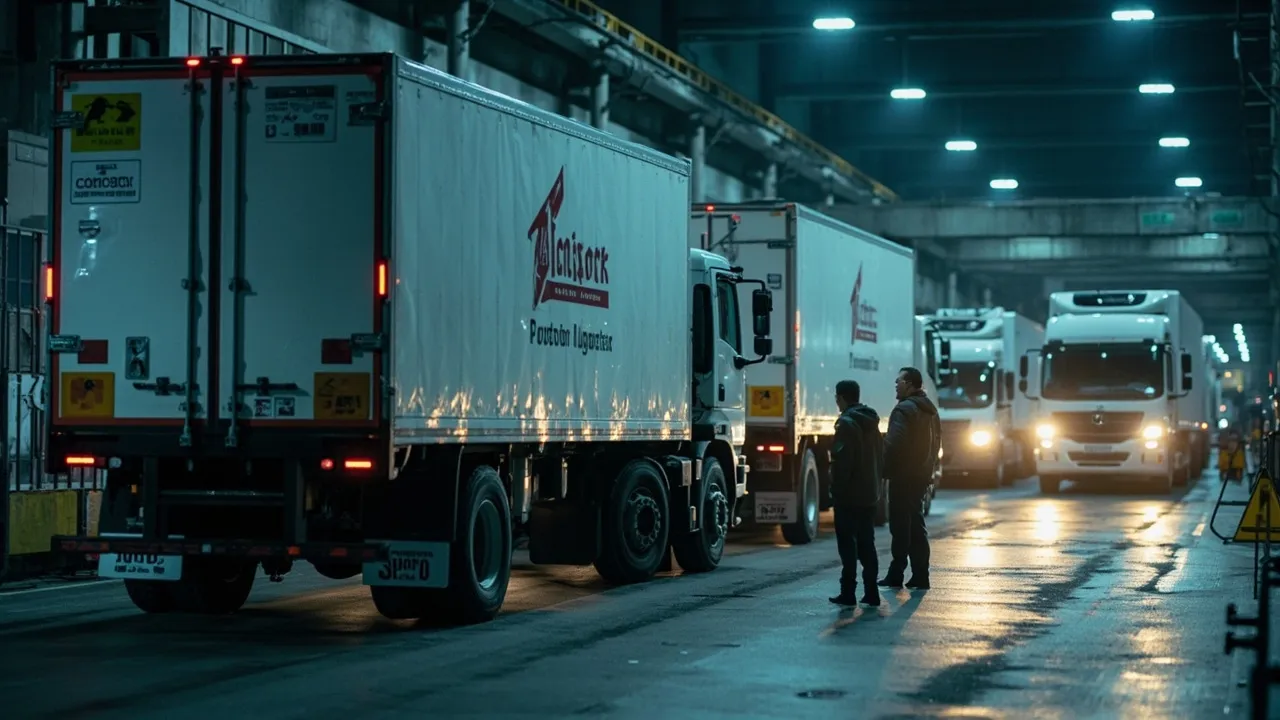
US Foods Expands Inventory-Scanning Robots: Measure Count Confidence Before Labor Savings


US Foods is widening its autonomous inventory-scanning robot test to six additional warehouses. That makes the program more than a technology demonstration: it is now a controlled multi-site experiment in whether machine observations can improve inventory confidence across different facilities.
The tempting headline is labor. US Foods CEO David Flitman said the technology costs roughly the equivalent of one worker, according to Supply Chain Dive. But labor equivalence is not the same as a business case. A robot can scan continuously and still produce little value if locations are missed, discrepancies wait in a queue, or the warehouse management system never receives an approved correction.
The first rollout gate should therefore be inventory confidence: how reliably robot observations become verified, timely, operationally useful inventory records.
Treat six warehouses as six comparable tests
A multi-site pilot creates an opportunity that a single showcase facility cannot. US Foods can compare performance across building layouts, product mixes, rack configurations, shifts, and operating teams. It can also identify which local conditions determine success.
Each warehouse should begin with the same baseline period and metric definitions. Record manual cycle-count results, adjustment volume, empty-location errors, replenishment shorts, picker-reported discrepancies, and the labor required to investigate them. Then stratify results by zone, storage type, item velocity, and shift.
That prevents a simple warehouse average from hiding weak spots. A robot may perform well in wide ambient aisles but miss labels in congested reserve storage or struggle where pallet presentation changes frequently. Those differences are not implementation trivia; they define where the technology can be trusted.
The six sites should use a common scorecard while preserving local detail. The goal is not to crown one warehouse the winner. It is to learn whether performance is repeatable and which operating conditions explain variance.
Measure count accuracy as a confidence system
“Scans completed” is an activity metric, not an inventory outcome. A useful scorecard needs at least four measures:
- Count accuracy: the share of robot observations confirmed by an independent physical count, measured at both location and item level.
- Missed-location rate: the percentage of eligible locations that produce no usable observation during a scheduled scan window.
- Exception age: elapsed time from a robot-detected discrepancy to review, disposition, and any approved inventory adjustment.
- Reconciliation time: total human minutes required to investigate and close each exception.
Accuracy should include false positives and false negatives. A false discrepancy creates unnecessary investigation; a missed discrepancy preserves bad inventory. Both consume capacity, but only the second may stay invisible until picking or replenishment fails.
Confidence also needs a freshness component. A correct observation that sits unresolved for two days may be less useful than a slightly less precise signal reviewed within an hour. Report the percentage of exceptions closed within defined service levels, not merely the number eventually resolved.
Keep observations separate from the system of record
The robot should initially be treated as a high-frequency observer, not an autonomous inventory accountant. Its output belongs in an observation layer containing the scan timestamp, location, item identifier, detected quantity or occupancy state, confidence score, image evidence, and device status.
The WMS remains the system of record. A rules-based workflow compares each observation with the expected balance and routes discrepancies by risk. A likely empty location with no open work may qualify for rapid review. A discrepancy involving active picks, inbound putaway, catch-weight products, or lot controls may require stronger evidence.
This separation creates an audit trail: what the robot saw, what the WMS believed, what work was active, who approved the adjustment, and what changed afterward. Without it, automatic corrections can conceal whether the underlying problem was receiving, putaway, picking, damage, or master data.
The approach aligns with a broader inventory lesson. Supply Chain Dive reports that Target is using AI and advanced data science to make faster inventory decisions. The value is not the observation alone; it is the decision process connecting data to availability.
Link robot findings to replenishment outcomes
Inventory accuracy matters because it changes execution. For every confirmed robot exception, track the next downstream event: replenishment created or prevented, picker short avoided, order substitution reduced, product located, damage identified, or no operational action required.
This produces an outcome yield: the share of verified discrepancies that lead to a useful intervention. A pilot with high scan accuracy but low outcome yield may be observing differences too small or too late to matter. Conversely, a modest number of early detections may carry substantial value if they prevent shorts on high-volume items.
Food distribution adds urgency. Product velocity, expiration constraints, temperature zones, and frequent location activity can shorten the useful life of an observation. Pilot reporting should therefore segment exceptions by item velocity and time sensitivity. A four-hour-old signal may still help in reserve storage but be obsolete in a fast-moving pick face.
Build a rollout gate before calculating labor savings
Expansion should require the technology to clear operational thresholds for multiple consecutive weeks. A practical gate would include:
- independently verified accuracy above the agreed target in every major storage zone;
- missed locations below a defined ceiling;
- most material exceptions reviewed within the operating service level;
- reconciliation time trending downward as teams learn the workflow;
- measurable reductions in picker shorts, emergency replenishments, or repeat adjustments;
- no weakening of lot, food-safety, or inventory-adjustment controls.
Only after these conditions hold should US Foods convert time reductions into financial savings. Time saved has value when it avoids overtime, supports more volume, reduces outside counting expense, or allows planned redeployment. It is not automatically cash because a dashboard reports fewer manual counts.
The reported one-worker cost benchmark is useful for setting expectations, but the decisive comparison is broader: verified operating benefit minus robot, integration, review, maintenance, and exception-handling cost. Count confidence is what makes that calculation credible.
US Foods' expansion can show whether autonomous scanning works across a real network rather than in one favorable building. The winning result is not a robot that travels the most aisles. It is a controlled process that finds meaningful discrepancies, resolves them quickly, improves replenishment, and leaves a defensible audit trail.
Ready to connect warehouse exceptions with transportation and fulfillment execution? Request a CXTMS demo to see how shared operational data can turn automation signals into accountable workflows.