A Taiwan Blockade Scenario Needs a Product-Level Continuity Trigger


A Taiwan Strait disruption is too consequential to leave in a quarterly risk register, yet too uncertain to justify buying months of inventory across every category. The practical middle ground is a product-level continuity trigger: a predefined signal that moves a specific item from monitoring to a specific operational response.
The pressure to build that mechanism is rising. A recent SupplyChainBrain discussion cited a survey of 100 supply chain executives in which nearly half believed China would use military force against Taiwan—through invasion or blockade—before 2030. That is not a forecast to treat as certainty. It is a warning that continuity plans need decision rules before news, rates, and lead times begin moving together.
Map exposure at the sellable-product level
Country-of-origin reporting alone will miss much of the risk. A finished product assembled in Mexico, Poland, or the United States may still depend on a Taiwan-fabricated semiconductor, specialized substrate, precision component, firmware supplier, or piece of production equipment. Another product may not contain Taiwan-origin content but still rely on Taiwan ports, nearby air capacity, or shipping lanes affected by military exercises and insurance restrictions.
The concentration is especially important for electronics. SupplyChainBrain has reported that Taiwan Semiconductor Manufacturing Company provides about 90% of advanced-design chips and 60% of semiconductor products overall. An older Reuters analysis similarly found that 92% of the most advanced chip manufacturing was located in Taiwan. The precise shares evolve as new fabs open, but the operational lesson remains: alternative capacity cannot be assumed merely because another supplier exists in a database.
Build the exposure map from customer-facing SKU backward. For each product, record:
- Taiwan-manufactured components and the factories, ports, and airports supporting them.
- Sole-source tools, materials, packaging, test operations, and intellectual property.
- Inventory by location and usable days of supply, including quality holds and allocations.
- Qualified substitutes, their available capacity, validation time, and engineering constraints.
- Open purchase orders, production milestones, transport bookings, and ownership terms.
- Revenue, contractual penalties, customer criticality, and time until lost sales begin.
This produces a continuity profile that an operations team can act on. “Exposure to Taiwan” is a risk label; “SKU 4812 stops in 24 days because its controller has no qualified substitute” is a decision input.
Use observable indicators, not headlines
A trigger should rely on facts the company can observe consistently. Political commentary may inform a scenario, but it is too subjective to release inventory budgets or change transport modes. Better indicators include canceled sailings, airspace or port restrictions, carrier advisories, war-risk insurance changes, supplier shutdown notices, booking rejection rates, lead-time growth, and failed production milestones.
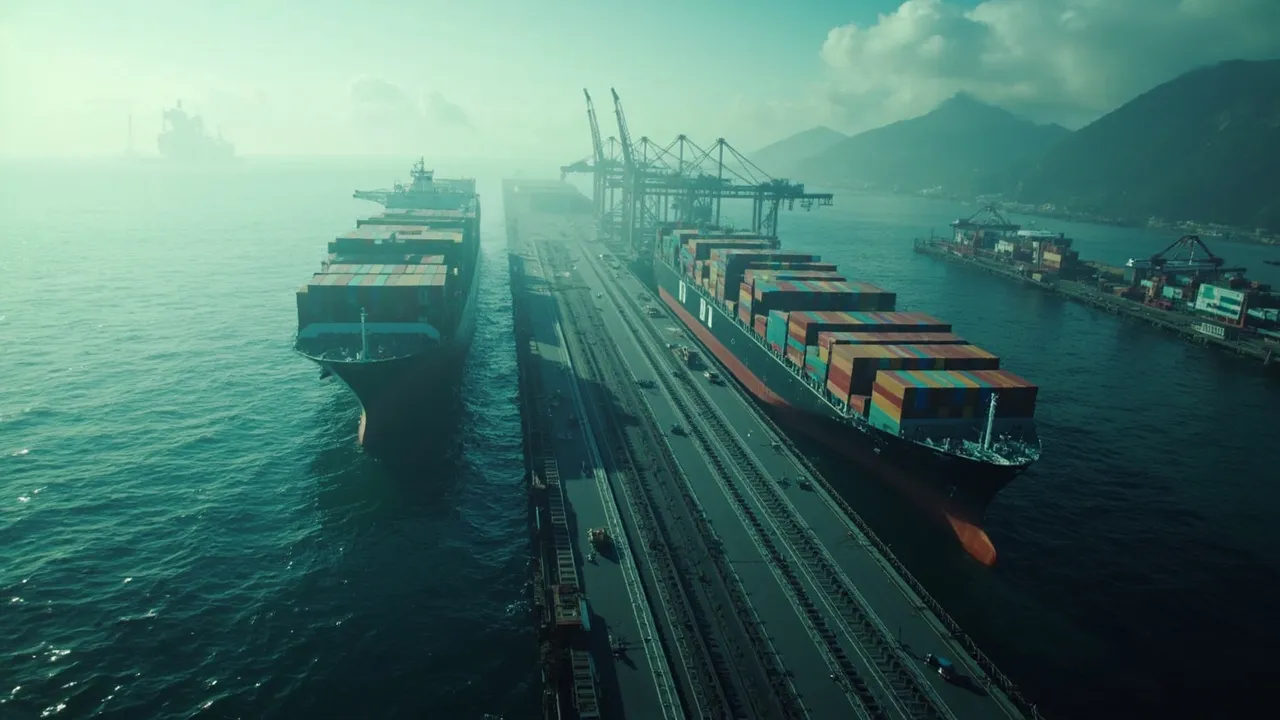
The transport exposure extends well beyond Taiwan-bound cargo. Reuters has reported that about half of global container ships pass through the Taiwan Strait. In a disruption, diversions, congestion, insurance costs, and equipment imbalances could therefore affect products with no Taiwanese content at all.
A three-stage trigger structure keeps decisions disciplined:
- Watch: Two or more risk indicators deteriorate. Validate supplier inventory, refresh demand, confirm carrier options, and review purchase-order milestones.
- Protect: A defined logistics restriction, supplier interruption, or material lead-time breach occurs. Reserve capacity, advance selected orders, rebalance inventory, or authorize a qualified substitute.
- Sustain: Product availability falls below its recovery horizon. Allocate scarce supply, switch production, activate alternate lanes, and communicate revised commitments to customers.
Each threshold needs an owner, data source, review frequency, approval limit, and expiration condition. Without an expiration rule, temporary emergency measures quietly become expensive permanent policy.
Rank actions by revenue at risk and substitution time
Blanket stockpiling treats all products as equally valuable and equally difficult to replace. They are neither. A better response compares the cost of protection with revenue and service at risk.
Start with two dimensions: days until the product becomes unavailable and days required to qualify a substitute. Then add contribution margin, customer importance, shelf life, obsolescence risk, storage cost, and the probability that extra supply can actually leave the region. A product with 15 days of inventory and a nine-month validation cycle deserves different action from a low-margin accessory with 90 days on hand and three approved sources.
The response menu should also be broader than “buy more.” Teams can advance a production lot, postpone a noncritical promotion, reserve air capacity, reposition inventory, redesign a bill of materials, preapprove a substitute, move test work, or negotiate controlled customer allocation. The least expensive action that preserves the required recovery time should win.
Connect triggers to transportation execution
Continuity decisions fail when the risk team identifies exposure but cannot see whether the protective order was produced, booked, picked up, or delayed. The trigger must create executable work in procurement, inventory, engineering, sales, and transportation systems.
For transportation teams, that means linking each priority SKU to purchase orders, shipments, routes, bookings, carriers, milestones, and alternate plans. A control tower should show both the inventory consequence of a delayed shipment and the shipment consequence of a product-level trigger. Exceptions can then be ranked by days of supply and revenue at risk instead of arrival time alone.
Measure the plan through decision latency, percentage of critical SKUs with verified multi-tier exposure, substitute qualification time, protected revenue per dollar spent, and the share of triggered actions completed before the continuity deadline. Run tabletop exercises that force teams to make real allocation and routing choices with imperfect information.
No company can predict the exact form or date of a Taiwan Strait crisis. It can decide, in advance, which evidence will prompt action and which products merit scarce cash, capacity, and management attention. That turns a geopolitical scenario from an abstract fear into a controlled operating process.
Ready to connect product priorities with shipment milestones and exception response? Request a CXTMS demo to see how centralized transportation visibility helps teams act on continuity triggers before supply becomes unavailable.