Arctic Shipping Ambitions Need a Seasonal Lane-Qualification Model

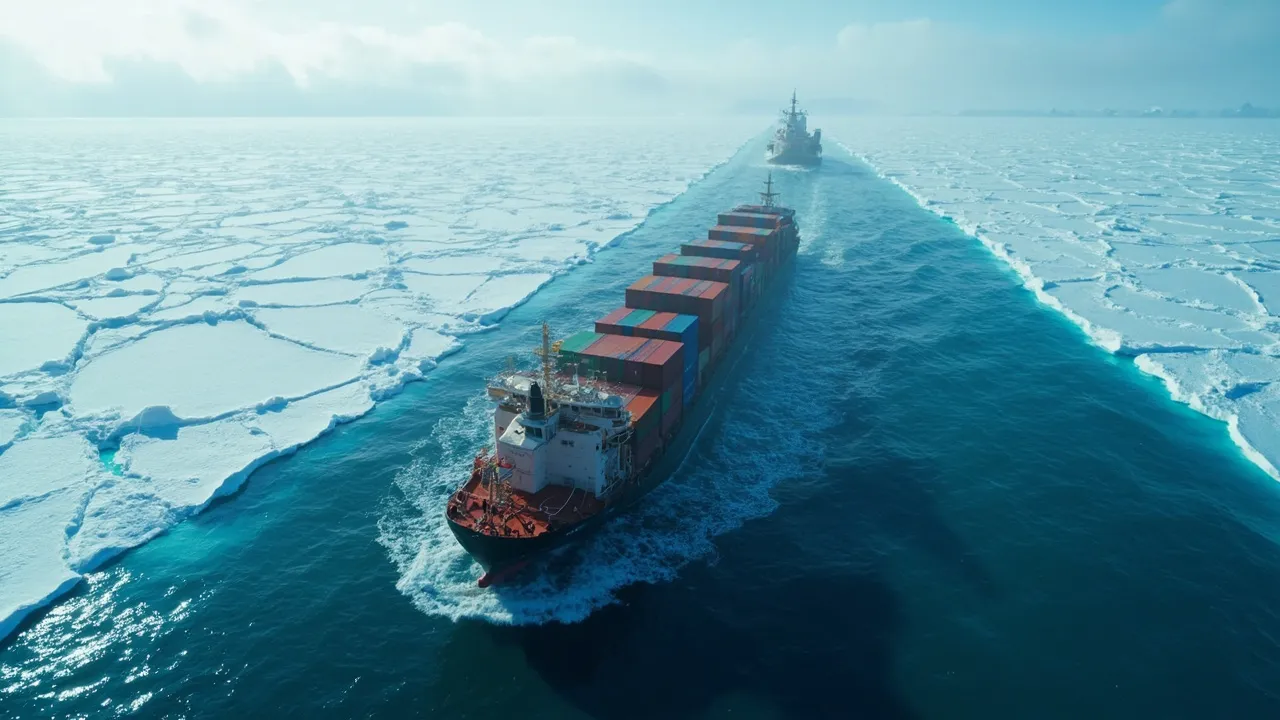
The commercial case for Arctic shipping often begins with a ruler. Draw a shorter line between Asia and northern Europe, compare it with the Suez route, and the fuel and transit-time savings appear compelling. But freight does not move across a map. It moves through ice, weather, regulatory zones, limited port infrastructure, sparse communications, and narrow rescue coverage.
That makes an Arctic route fundamentally different from a permanent ocean service. Shippers should qualify it as a time-bounded lane whose approval depends on a specific vessel, voyage window, cargo, service network, and recovery plan. When any of those conditions expires or changes, the lane should be reassessed automatically.
Distance savings are real—but incomplete
The Northern Sea Route can offer substantial savings on selected port pairs. FreightWaves reports that the route from Shanghai to northwestern Europe is about 27% shorter than sailing through the Suez Canal. Another FreightWaves analysis put Shanghai-to-Rotterdam at roughly 8,100 nautical miles, about 2,400 nautical miles shorter, with the operating season historically concentrated between July and November.
Individual voyages show both the upside and the qualification problem. Reuters reported that the Istanbul Bridge reached Europe in about 20 days, versus the 40 to 50 days cited for the Suez route. Yet the voyage was initially expected to take 18 days and lost two days to a storm off Norway. A fast result did not eliminate schedule variance; it demonstrated why planners must model it.
The wrong conclusion is that a 27% shorter route produces a 27% better service. Distance is only one variable. Ice concentration and movement can change safe speed or require rerouting. An escort may be available but not on the required day. A vessel may hold an appropriate ice class yet face cargo-system, crew-experience, or machinery limitations. Insurance terms can change with geography and season. A port that can receive the ship may lack the repair, salvage, storage, or onward capacity needed after an exception.
Score the whole voyage, not just the sea lane
A practical qualification model begins with a voyage-specific scorecard. It should record the forecast ice regime and confidence range, the vessel's Polar Class or equivalent notation, escort requirements, icebreaker availability, master and crew experience, and the latest permissible entry and exit dates.
It also needs commercial and response data:
- Hull, cargo, war-risk, pollution, and delay coverage, including deductibles and exclusions.
- Available ports of refuge, maximum draft, repair capability, storage space, and alternate discharge options.
- Satellite and terrestrial communications coverage, expected outages, position-reporting frequency, and escalation paths.
- Search-and-rescue assets, estimated response times, medical evacuation options, and spill-response capability by voyage segment.
- Icebreaker booking status, cancellation terms, convoy rules, and the operational cost of waiting.
These inputs should not collapse into a single opaque green score. Dispatchers need to see which condition drives the result. A lane might be acceptable for a nonperishable project shipment with generous delivery tolerance but unacceptable for temperature-sensitive pharmaceuticals, launch-critical components, or seasonal retail inventory.
The route's operating status should therefore combine a minimum safety gate with a cargo-specific commercial threshold. Failure of a mandatory safety requirement closes the option. Commercial factors then rank the viable routes by expected landed cost and service risk.
Price schedule variance and recovery cost
Planners should compare scenarios, not best-case transits. For each Arctic option, calculate an expected arrival range using normal passage, escort waiting, reduced-speed sailing, weather deviation, and closure cases. Then attach inventory carrying cost, stockout exposure, charter or detention charges, missed-connection cost, and the expense of recovery.
Recovery deserves special weight because alternatives are scarce. On a mature trade lane, a carrier may transship cargo, divert to another hub, or substitute capacity within days. In the Arctic, the nearest suitable port may be far away and may not support the vessel or cargo. A mechanical problem that would cause a modest delay elsewhere can become an expensive tow, seasonal trapping risk, or total schedule failure.
Cargo value alone is not the deciding factor. High-value electronics may justify a shorter journey but have little tolerance for moisture, shock, or a missed product launch. Bulk commodities may tolerate time variation but create large salvage and pollution exposure. Refrigerated cargo depends on redundant power, reefer technicians, spares, and emergency discharge capacity. Each shipment profile requires its own maximum acceptable delay and recovery-cost ceiling.
Make qualification expire automatically
An Arctic lane should never remain approved because it worked last year. Its qualification record needs an effective date, an expiration date, and events that force immediate review. Those events include material ice-forecast changes, vessel substitution, lapsed insurance, lost escort confirmation, communications degradation, port restrictions, geopolitical or sanctions changes, and a revised cargo hazard or temperature profile.
The expiration date should fall before the weakest supporting evidence expires. If insurance approval ends on October 10, an ice-service forecast is valid through October 15, and the planned seasonal cutoff is October 20, the route cannot remain qualified through October 20. It expires on October 10 unless coverage is renewed and recorded.
This structure also improves governance. The shipment record can preserve the forecast, documents, risk score, approver, route alternatives, and reason for the final decision as they existed at booking. If conditions change during execution, the system can show the new evidence, who accepted the exception, and which recovery plan was activated.
Turn ambition into controlled execution
CXTMS can manage Arctic services as conditional lane records rather than permanent network edges. Teams can link vessel and insurer documents, escort confirmations, seasonal dates, ports of refuge, cargo requirements, and contingency milestones to the booking. Automated expiry prevents yesterday's approval from becoming tomorrow's hidden assumption, while exception workflows put changed conditions in front of an accountable reviewer.
Arctic shipping may become more commercially useful, and particular voyages can already deliver major time savings. But shorter is not the same as dependable. The disciplined approach is to qualify the exact voyage for the exact season and cargo—and let that approval expire when its evidence does.
Ready to build time-bounded lane qualification and voyage-risk controls into your ocean workflow? Request a CXTMS demo and manage every route against current operating evidence.